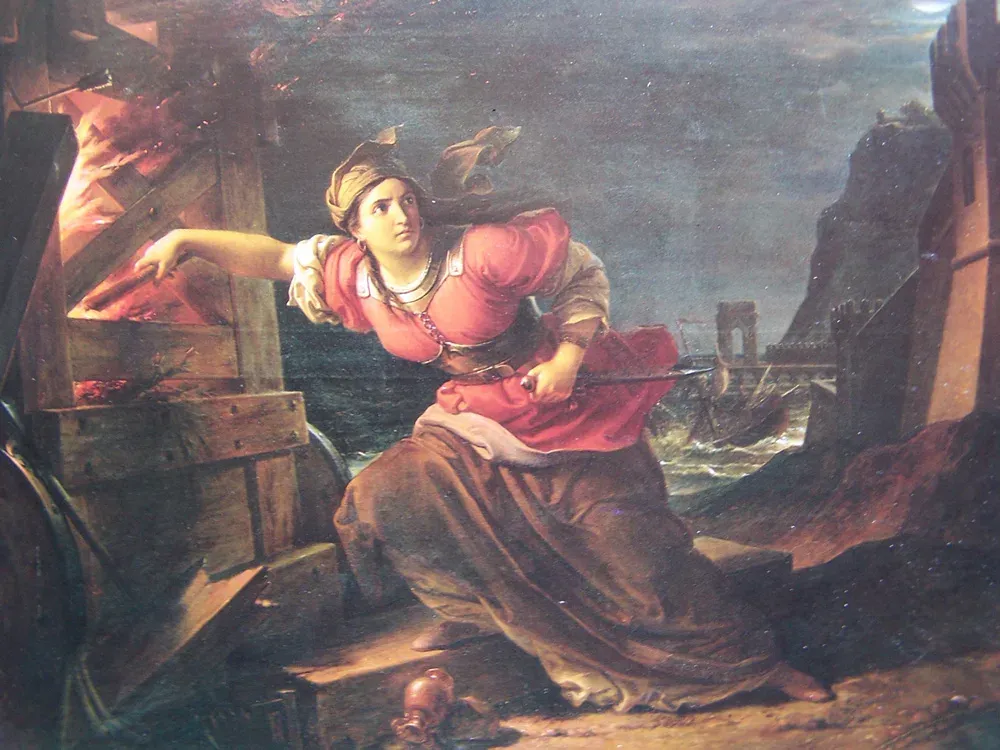
We live in an exhausting culture of transactional calculus. Every human gesture is interrogated for its hidden incentive, its brand alignment, or its return on investment. Altruism is treated with instant suspicion; self-sacrifice is diagnosed either as a psychological pathology or as crude wartime propaganda. We have become so thoroughly marinated in cynicism that the idea of someone willingly destroying themselves for the survival of strangers feels not merely obsolete, but almost fictional.
Which is why the story of a destitute woman outside the walls of Ancona on 1 September 1173 is so disorienting.
In medieval chronicles, one expects to find kings bargaining for dynastic territory, mercenary captains haggling over ransom payments, and prelates trading spiritual absolution for secular land. The twelfth century in northern Italy was an arena of savage commercial greed and political betrayal. Yet right in the middle of it, according to the Bolognese rhetorician Boncompagno da Signa, a widow named Stamira picked up an axe and a torch, walked straight into the kill-zone of imperial archers, and did something for which she could never collect a reward.
The context was the endless, grinding conflict between the Holy Roman Empire and the free Italian communes. Emperor Frederick Barbarossa was determined to crush the autonomous maritime republics that dotted the peninsula and bring them beneath German feudal dominion. Ancona, an ancient port clinging to the rocky promontory of Mount Conero, was a particularly irritating thorn in the imperial side. The city had already repelled an imperial assault in 1167, ran its own civic democracy, and maintained a lucrative trade alliance with the Byzantine Emperor Manuel I Komnenos in Constantinople. To the Hohenstaufen court, Ancona was an intolerable nest of Greek-loving rebels.
Barbarossa did not oversee the siege in person. He delegated the task to his most capable warlord: Christian von Buch, the Archbishop of Mainz. Christian was the supreme embodiment of the militarised medieval churchman - an imperial chancellor who spent far more time encased in mail directing catapult batteries than he ever did saying Mass. To ensure Ancona was thoroughly strangled, Christian secured an alliance with the Republic of Venice. The Venetians were nominally part of the anti-imperial Lombard League, but when presented with an opportunity to eliminate a bitter commercial rival that competed for maritime routes in the Adriatic, civic solidarity evaporated. Venice provided a blockade fleet of galleys to seal the harbour, while Christian’s German mercenaries and feudal levies threw an iron cordon around the landward walls.
The siege began in late May 1173. By late summer, the city was reduced to absolute agony.
Boncompagno, who compiled his Liber de obsidione Ancone three decades later from the testimony of surviving citizens, recorded the squalor of urban starvation with unsparing clarity. As the months dragged on under the Mediterranean sun, the defenders exhausted their stockpiles of grain, livestock, and salted fish. Wealthy citizens boiled old horsehides, shield leather, and wild sea-grass to make watery broth. Gold and silver became worthless metal on the streets; a nobleman would trade a fortune in Byzantine coin for a handful of wild beans. Mothers starved so their infants might nurse on blood instead of milk. When Christian of Mainz sent envoys offering to spare the lives of the populace if they surrendered unconditionally and paid a ruinous tribute, the communal council refused. They knew what imperial justice looked like.
By late August, the imperial besiegers were ready to force the issue. Christian’s engineers had constructed massive wooden siege engines - heavily timbered belfries and mobile towers clad in wet hides to resist flaming arrows - and were rolling them toward the city’s crumbling outer barricades. If those towers reached the walls, German assault troops would storm the ramparts and the slaughter would begin.
The Anconetani mounted a desperate sortie. A group of defenders managed to haul a heavy wooden barrel filled with pitch, tar, and resin into the open ground near the base of the imperial towers. But dropping the fuel was only half the problem. The barrel sat in no man’s land, unlit, directly under the sights of imperial crossbowmen and archers. To run out into the open, crack open the wooden staves, and set the pitch ablaze was a suicide mission. The men who had carried the barrel stalled; none of the soldiers were willing to trade their lives for a torch that might be snuffed out by an arrow before it ever touched the wood.
That was the moment Stamira stepped forward.
She was not a noblewoman protecting private estate titles, nor a knight seeking chivalric glory, nor an elected magistrate answering to the assembly. She was an ordinary widow whose previous life is a total blank in the historical record. Wielding an axe and carrying a lit torch, she walked out past the city gate alone. Under a hail of imperial missile fire, she marched directly to the barrel, smashed the staves with repeated blows, and thrust her torch into the resin.
The pitch caught with an explosive roar. A wall of fire swept through the imperial assault engines, jumping from the resin-soaked ground to the wooden scaffolding of the towers. In the confusion, heat, and smoke, Stamira was cut down and killed on the scorched dirt. But the damage was done: the pride of imperial siege engineering went up in ash before the eyes of the German army. The blaze threw the besieging lines into chaos, provided cover for the Anconetani to mount fresh sorties to forage for provisions, and bought the garrison the one thing it needed most: time.
That time proved decisive. In mid-October, relief columns organised by Countess Aldruda Frangipane of Bertinoro and the Guelph nobleman Guglielmo Marcheselli of Ferrara appeared in the hills above the city. By lighting hundreds of bonfires and torches across the ridges at night, they tricked Christian of Mainz into believing a massive royal army had encircled his camp. The Archbishop and his Venetian allies broke their siege lines and withdrew. Ancona had survived.
Historians, naturally, have argued over the details ever since. Boncompagno was a master of rhetoric who loved dramatic exempla of civic virtue, and during the nineteenth-century Risorgimento, Italian nationalist writers transformed “Stamura” into an elaborate romantic heroine. The novelist Giuseppe Cannonieri gave her an invented martyr husband, a fictional lover, and operatic monologues; the Anconetan painter Francesco Podesti put her on vast academic canvases as an icon of proto-Italian resistance against Germanic tyranny.
All of that nineteenth-century varnish was romantic projection. In 1173, there was no concept of a unified Italian nation, and Ancona was fighting for its own communal skin, not a nineteenth-century republic.
Yet strip away the nationalist mythmaking and you are left with the stubborn, irreducible core of Boncompagno’s chronicle: the memory of a widow who stepped into a breach that armed men refused to enter. She had no political office to retain, no dynasty to inherit her glory, and no realistic prospect of surviving the blaze.
In an age like ours - where every action is assumed to be an angle and every sacrifice is reduced to performative posturing - Stamira’s choice feels like a message from an alien civilisation. We are conditioned to believe that self-preservation is the only logical compass and that whoever dies without collecting the spoils has lost the game. But every so often, history throws up a figure who refuses that small, self-absorbed arithmetic. Maybe the story has gathered legend over eight centuries; chronicles are never pure transcripts. But the image of an anonymous widow walking into an arrow storm with an axe and a torch remains an enduring, devastating rebuke to our cynical certainties. Some people do not calculate the cost. They simply strike the match.