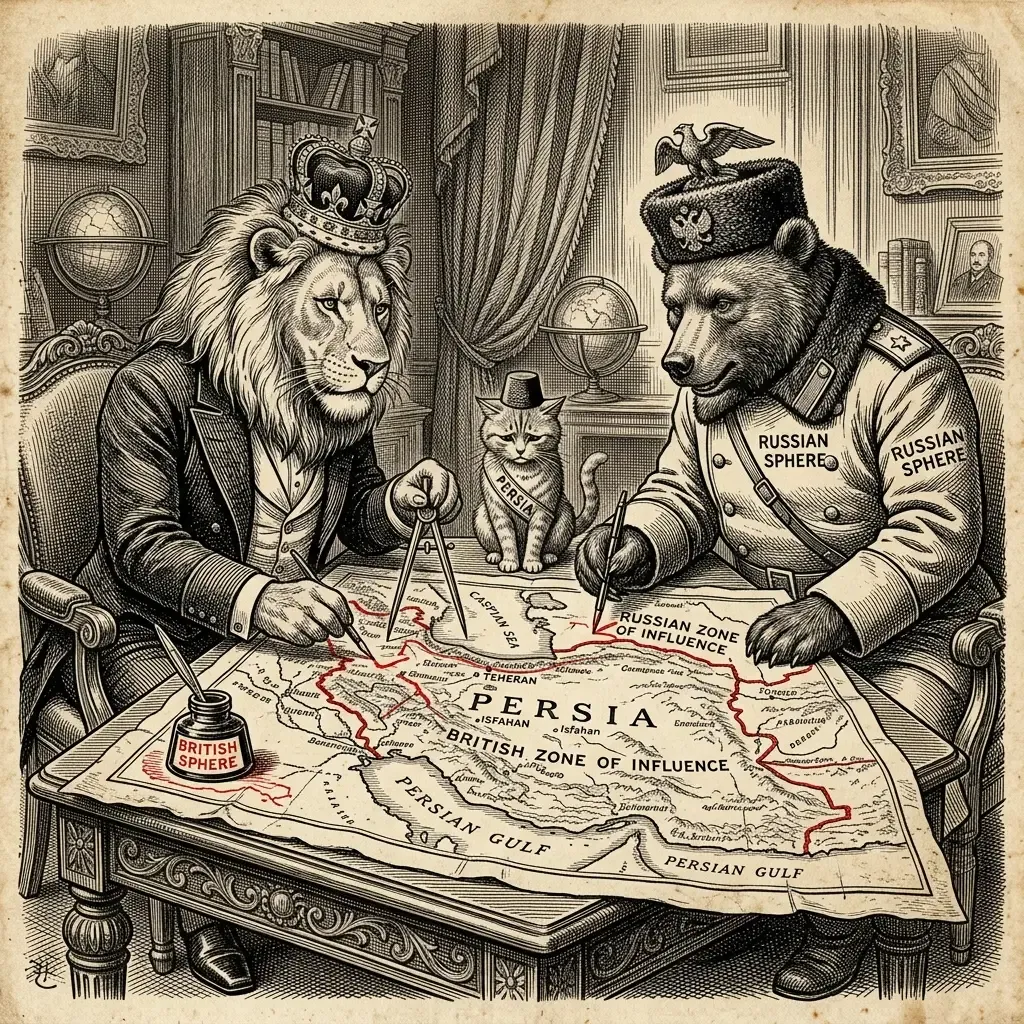
On 31 August 1907, in the marble halls of the Russian Foreign Ministry in St Petersburg, Sir Arthur Nicolson and Count Alexander Izvolsky sat down with fountain pens and settled an empire. Nicolson was the British ambassador; Izvolsky was Tsar Nicholas II’s foreign minister. Between them lay a series of diplomatic agreements designed to resolve every major point of friction between London and St Petersburg from the roof of the world down to the Persian Gulf. In three separate conventions, they dealt with Tibet, Afghanistan, and Persia. Tibet was neutralized; Afghanistan was assigned to Britain’s sphere of interest; and Persia — an ancient, sovereign nation of nine million souls — was neatly carved into three zones. Russia took the wealthy, populous north. Britain took the arid southeast bordering India. A strip of desert and mountain was left in the middle as a neutral buffer.
Nobody in St Petersburg thought to invite a Persian to the room. When the text of the treaty was published in Tehran a few weeks later, the members of the Majles — Persia’s newly elected parliament, barely a year old — learned from foreign newspapers that their country had been partitioned by two foreign powers who had not even bothered to declare war.
The Anglo-Russian Convention was the final puzzle piece in the diplomatic revolution that shaped the twentieth century. Three years earlier, Britain and France had signed the Entente Cordiale, burying nine centuries of warfare over fishing rights and colonial borders in North Africa. Now, Britain and Russia did the same for the “Great Game” — the decades-long Victorian cold war waged across the high passes of the Hindu Kush and the deserts of Central Asia. London had spent the nineteenth century terrified that Russian Cossacks would march through the Khyber Pass into British India; St Petersburg had pushed its railways and garrisons south, absorbing Tashkent, Samarkand, and the Central Asian khanates.
What broke the stalemate was not goodwill, but a mutual panic named Germany. Kaiser Wilhelm II was constructing a battle fleet designed to challenge the Royal Navy in the North Sea, while German bankers were financing the Berlin-to-Baghdad railway, threatening both British supply lines and Russian ambitions in the Near East. For Russia, fresh from its catastrophic defeat in the Russo-Japanese War and crippled by the revolution of 1905, an accommodation with London offered financial breathing room and a chance to stabilize its bankrupt borders. For Britain, it secured the landward approaches to India without the ruinous cost of stationing larger garrisons. Slicing up Persia was simply the currency with which two European empires purchased each other’s friendship.
In London, Punch magazine captured the transaction with devastating accuracy in a cartoon titled The Harmless Necessary Cat. The British Lion and the Russian Bear lean over a small, bewildered Persian cat sitting between them. “Look here!” says the Lion to the Bear. “You can play with his head, and I can play with his tail, and we can both stroke the small of his back.” The cat mutters: “I don’t remember having been consulted about this!”
For Persians, the insult was not just that they had been carved up without a word. It was that this was only the latest in a century-long catalogue of imperial amputations.
Throughout the nineteenth century, the declining Qajar dynasty had suffered one humiliating defeat after another at the hands of the Tsarist army. In the Russo-Persian Wars of 1804–1813 and 1826–1828, Persia had been stripped of its Caucasian provinces — territories that had formed part of the Iranian cultural and political world for millennia. The Treaty of Gulistan in 1813 severed Dagestan, eastern Georgia, and northern Azerbaijan. Fifteen years later, the Treaty of Turkmenchay forced Persia to surrender everything north of the Aras River, including Yerevan and Nakhchivan, while imposing crippling war indemnities and extraterritorial capitulations that exempted Russian citizens from Persian law. In the Iranian historical consciousness, “Turkmenchay” remains to this day the supreme synonym for national shame and betrayal.
Then came the bitterest twist of all: oil.
The very Caucasian lands Russia had violently sheared away from Persia in the 1810s and 1820s — specifically the Absheron Peninsula around Baku — became the scene of the world’s first true petroleum boom. By the turn of the twentieth century, Baku’s forest of wooden derricks was pumping over half of the world’s total crude output. The Nobel brothers (Robert and Ludvig with their Branobel empire) and the Rothschilds built colossal industrial fortunes on territory that had been Persian within living memory. Russian state coffers swelled with revenue extracted from soil that Qajar shahs had signed away in panic. Persia received not a single kopeck.
To make matters worse, the same predatory dynamic immediately migrated south. In 1901, a British adventurer named William Knox D’Arcy had extracted a sixty-year concession from the cash-strapped Mozaffar al-Din Shah for the right to explore for oil across three-quarters of Persia’s territory. In May 1908 — less than a year after the Anglo-Russian Convention was signed — D’Arcy’s drilling team struck oil at Masjed Soleyman in the foothills of the Zagros Mountains. Out of that discovery sprang the Anglo-Persian Oil Company, later rebranded as British Petroleum. For the next four decades, Britain extracted millions of barrels of Persian oil to fuel the Royal Navy, paying Tehran a fraction of the profits while treating southwestern Iran as a private company estate.
The tragedy of the 1907 Convention was compounded by its timing. Persia was in the midst of its Constitutional Revolution (1905–1911), one of the most remarkable democratic experiments in Asian history. A coalition of bazaar merchants, progressive intellectuals, and Shia clerics had forced the Shah to accept a constitution and establish the Majles, hoping to end royal tyranny and build a modern, sovereign nation-state.
Instead, the two European powers worked systematically to strangle it. When Mohammad Ali Shah Qajar attempted a royalist coup in June 1908, the Persian Cossack Brigade — commanded by Russian Colonel Vladimir Liakhov — bombarded the Majles building in Tehran with artillery. When the constitutionalists fought back, took the capital, and hired an idealistic American financial expert named Morgan Shuster to clean up the country’s corrupt tax system in 1911, Russia saw an immediate threat to its economic control. St Petersburg issued an ultimatum demanding Shuster’s expulsion, backed by a British nod. Russian troops invaded northern Iran, occupied Tabriz, and publicly hanged leading constitutionalists on the holy day of Ashura. Shuster was dismissed, and upon returning to the United States published his scathing indictment of Anglo-Russian imperialism: The Strangling of Persia.
When the First World War broke out in 1914, Persia declared strict neutrality. It did not matter. Because the country had already been partitioned into de facto colonial spheres, Russian, British, and Ottoman armies marched across its territory at will, fighting battles on Persian soil, confiscating grain, and requisitioning livestock. The resulting Persian Famine of 1917–1919 — worsened by drought, military requisitions, and British army hoarding — killed an estimated two million people, roughly a fifth of the entire population. It was one of the worst civilian catastrophes of the Great War, and one of the least remembered in the West.
Western textbooks tend to remember 31 August 1907 as a triumph of classical balance-of-power diplomacy — the stroke of a pen that completed the Triple Entente alongside France, ring-fenced Imperial Germany, and set the board for 1914. But in the Middle East, the Anglo-Russian Convention was something very different: an object lesson in the complete worthlessness of international law when great powers decide to bargain.
Every major convulsion in twentieth-century Iranian history flows from the reservoir of distrust filled by agreements like 1907. It explains why Reza Khan was able to seize power in 1921 on a wave of nationalist disgust with foreign meddling, as I wrote in The Pahlavis. It explains why the joint Anglo-Soviet invasion of Iran in 1941 felt so horrifyingly familiar. It explains the popular fury behind Mohammad Mossadegh’s nationalization of Iranian oil in 1951, and the enduring rage when the CIA and MI6 toppled him in 1953. And it explains why Ayatollah Khomeini found such fertile ground in 1979 when he denounced foreign imperialism, a theme explored in The Homecoming.
When Western commentators express bafflement at Iranian suspicion toward foreign intentions, they reveal only their own historical amnesia. Iranians have not forgotten the afternoon when two empires drew a line through their country, took what they wanted, and left a civilization to pay the bill.