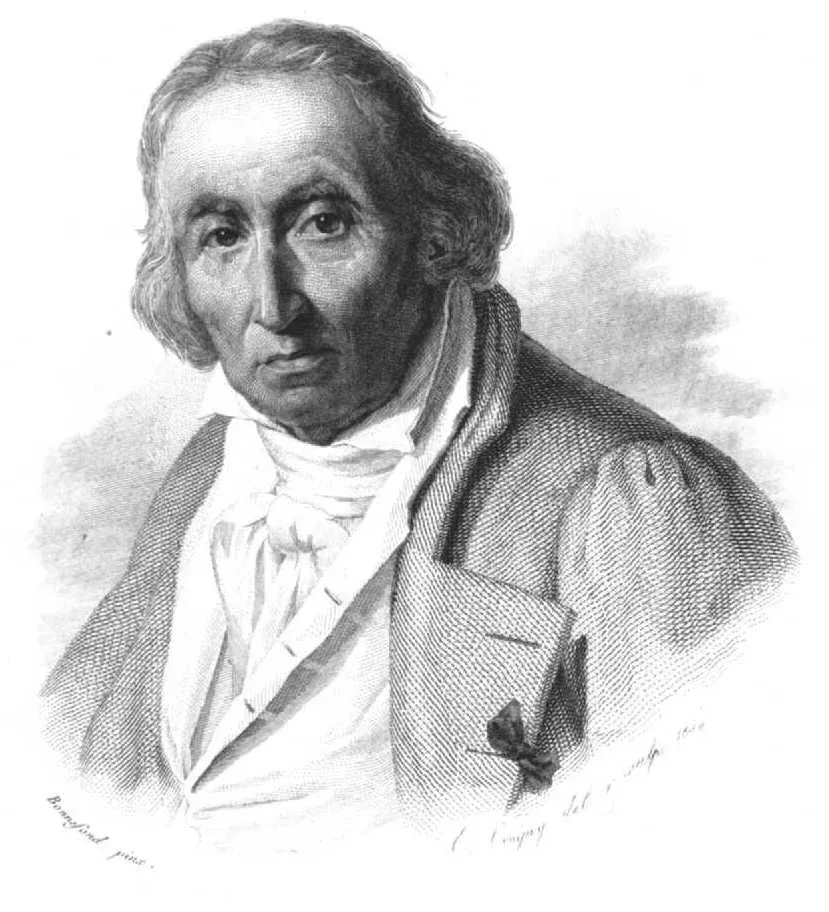
In 1804, a tribunal in Lyon seized Joseph Marie Jacquard’s automated loom, dragged it into a public square, and dismantled it in front of a crowd. The iron went to a scrap merchant. The wood went to a woodcutter. Jacquard later described the outcome in his own words: the iron was sold as iron, the wood as wood, and he, the inventor, was “delivered over to universal ignominy.” Mobs broke into his house on more than one occasion. His machines were smashed. He was attacked in the street. For a while he lived in hiding, a man who had built something that worked so well that an entire trade wanted him dead for it.
Jacquard did not arrive at that loom easily. Born in Lyon in 1752 to a master weaver, he was illiterate until he was thirteen and inherited his father’s workshop, house, vineyard, and quarry when he was twenty. He lost most of it within a few years - a failed weaving venture left him so deep in debt that he had to sell the inheritance and raid his wife’s dowry to cover it. Between then and his forties he tried type-founding, cutlery, straw-hat bleaching, and soldiering in the Rhine campaigns, where by one account his teenage son was killed outside Heidelberg. None of it settled him. What finally did was a problem other inventors had already spent seventy years failing to solve: how to make a loom weave a complicated pattern without a second person sitting inside it, by hand, pulling the right threads at the right moment.
The groundwork existed. Basile Bouchon had rigged a loom to a punched paper roll in 1725. Jean-Baptiste Falcon replaced the roll with a chain of punched cards in 1728. Jacques de Vaucanson automated the mechanism further in the 1740s, though his version still needed more warp threads than it could control to weave anything worth the expense. Each of these machines was a partial answer, shelved because it couldn’t do enough to justify itself. Jacquard, working at the Conservatoire des Arts et Métiers in Paris on Vaucanson’s old equipment, combined Falcon’s punched cards with Vaucanson’s automated hooks and added enough capacity to make the thing genuinely useful. Feed it a chain of cards, and the loom would raise precisely the warp threads a pattern required, row by row, without a draw-boy calling instructions from inside the frame. The pattern was no longer held in a craftsman’s memory. It was punched into cardboard.
That was exactly the problem, from where the Lyon weavers stood. A loom that didn’t need a second skilled worker inside it was a loom that made a second skilled worker’s job disappear. The canuts of Lyon had spent generations building a trade around precisely that kind of specialised, hard-won labour, and here was a machine reducing it to a stack of cards anyone could feed through a cylinder. Their response wasn’t a petition. It was destruction - Jacquard’s workshop broken into, his looms smashed, the machines paraded to a public square and reduced to scrap by official order, the inventor himself hunted through the streets he’d grown up in.
The reversal, when it came, was total. Napoleon Bonaparte, trying to keep French silk competitive against Britain’s mechanised mills, visited Lyon in April 1805 with Empress Josephine to inspect the loom personally. Within days he granted the patent to the city of Lyon and gave Jacquard a lifelong pension of 3,000 francs plus a royalty on every machine sold. The loom was declared public property in 1806. The same weavers who had thrown Jacquard’s machines to the scrap merchant started buying them - by 1812 there were 11,000 in operation across France. In 1819 he received the Cross of the Legion of Honour. He died at his home in Oullins, near Lyon, on 7 August 1834, aged eighty-two, a decorated man rather than a hunted one. Six years later the city put up a statue of him on the exact spot where his loom had been broken apart. Lyon had, in the space of one lifetime, gone from selling the man’s iron by weight to casting him in bronze.
None of that is the most consequential part of the story. The real inheritance of the Jacquard loom wasn’t woven cloth at all - it was the idea sitting underneath the cloth. A punched card is a physical record of instructions, storing a pattern that a machine can read and execute without a human interpreting it in real time. Swap out the warp threads for anything else a machine can raise or lower, and you have a general method for storing instructions outside a human brain. In 1839, a silk portrait of Jacquard was woven on one of his own looms using roughly 24,000 punched cards - a single image encoded as tens of thousands of binary decisions, hole or no hole. Charles Babbage owned one of these portraits and later said explicitly that Jacquard’s cards had shown him how to feed instructions into his Analytical Engine, the mechanical computer he designed but never finished. Decades after that, Herman Hollerith adapted the same punched-card principle to tabulate the 1890 US census, and the company he founded to sell his tabulating machines eventually became IBM. Punched cards stayed in commercial use in computing into the 1980s - close to two centuries after a Lyon crowd melted Jacquard’s prototype down for scrap value.
The weavers who destroyed his machines weren’t wrong that something important was ending. A trade built on the specific, embodied knowledge of one skilled person sitting inside a loom really was being replaced by a trade built on a portable, transferable set of instructions that anyone could load and run. They were simply wrong about which side of that change would matter more. Jacquard set out to automate silk weaving and largely succeeded at exactly that, modestly, in one French city. What he actually invented was a way to store a set of instructions as physical, readable holes and hand them to a machine - and that idea outgrew silk so completely that the loom is now mostly a historical footnote to the thing it was quietly rehearsing all along: a computer, reading its program off a card.