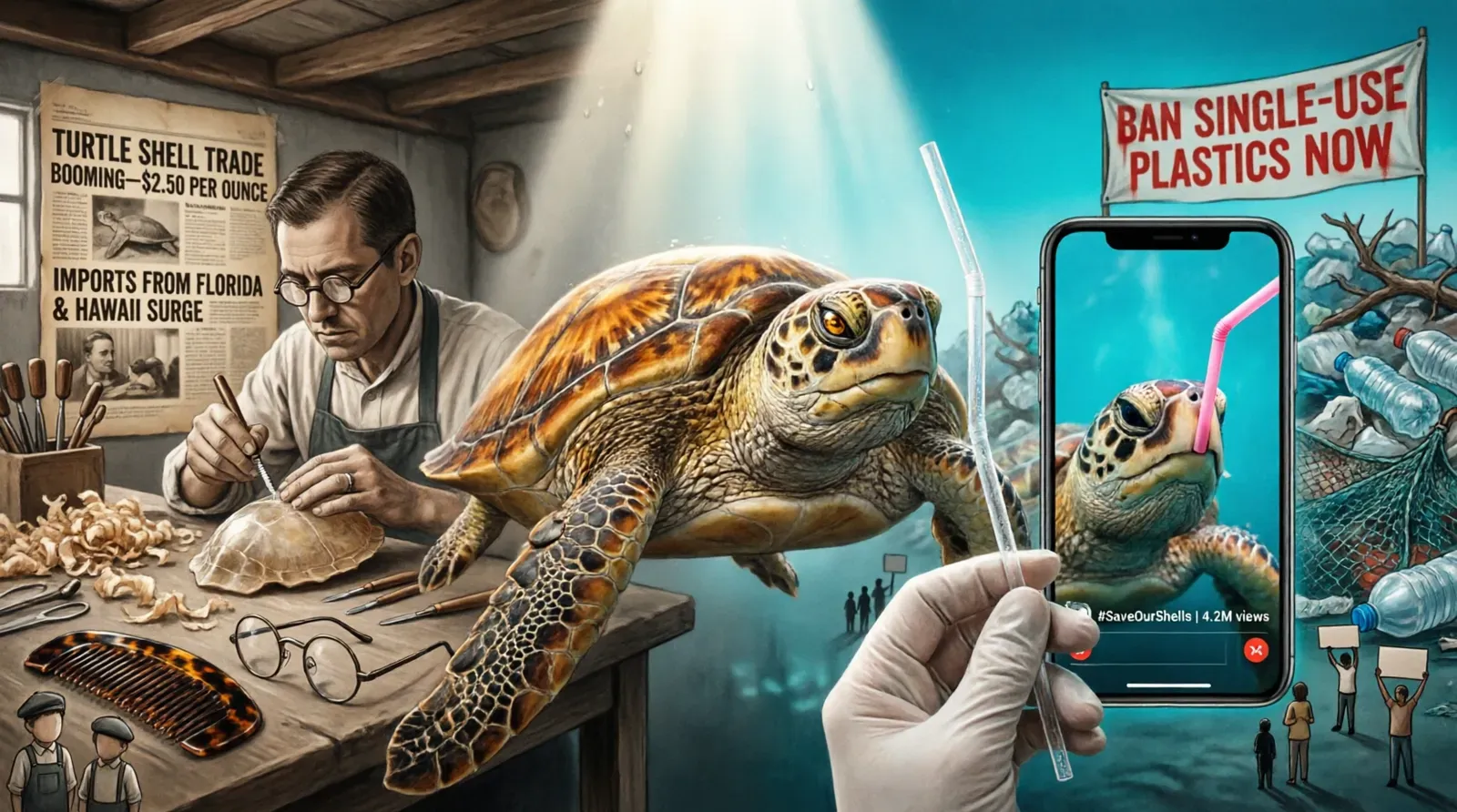
A few years ago, a short video clip conquered the internet. It showed a distressed olive ridley sea turtle on a research boat off the coast of Costa Rica, bleeding from its right nostril. A team of young marine biologists had discovered a ten-centimetre object wedged deep inside the animal’s nasal cavity. With a pair of Swiss Army pliers, they spent eight agonising minutes pulling at the obstruction while the turtle hissed, writhed, and bled onto the deck.
The human rescuers suffered on camera in perfect synchrony with the beast. A young, photogenic researcher shouted instructions and winced through her tears, looking simultaneously vulnerable, heartbroken, and horrified. When the bloody cylinder finally popped free, the villain was revealed: a common, single-use plastic cocktail straw.
The internet did what the internet always does when confronted with high-definition suffering and telegenic virtue: it lost its mind. The turtle’s pain became our collective guilt, and the humble plastic straw became public enemy number one.
That eight-minute clip is the direct reason why, across coffee shops and fast-food chains on three continents, you are now forced to drink your iced latte through a sodden cylinder of recycled cardboard. You know the experience well. Within three sips, the paper absorbs the liquid; within five minutes, it collapses into structural mush; by the time you reach the bottom third of your milkshake, you are sucking tepid sludge through a disintegrating lump of wet pulp.
We accepted this daily annoyance because we were told it was the price of redemption. The straw was the proverbial straw that broke the back of global apathy. Activists demanded total prohibitions. Corporate boards rushed to replace plastic stirrers with wooden splinters and paper tubes, congratulating themselves on their environmental stewardship while wrapping their sandwiches in four layers of bleached plastic film. To some of the louder voices in the room, the straw was merely the gateway drug: all synthetic polymers ought to be outlawed, banished from civilization to return the planet to its pristine, pre-industrial innocence.
It is an inspiring moral fairy tale. It also suffers from a total ignorance of material history. Before anyone rushes to banish plastic from the face of the Earth to save the testudines order, it is worth stating a simple, documented historical fact out loud: before there was plastic, the turtles were the plastic.
For several centuries, European and American consumer culture ran on animal-based raw materials that filled the exact commercial niche now occupied by synthetic polymers. If you needed something lightweight, waterproof, rigid yet malleable under heat, and capable of holding an intricate shape, you did not use petroleum derivatives. You used horn, whale baleen, ivory, or, most prized of all, tortoiseshell.
Tortoiseshell did not actually come from tortoises. It came from the carapace of the hawksbill sea turtle, a magnificent marine reptile native to tropical coral reefs. The plates of keratin covering the hawksbill’s shell possessed unique thermoplastic properties. When soaked in boiling salt water and pressed with hot irons, the shell softened, welded seamlessly to other pieces, and could be moulded into almost any domestic luxury goods a polite society demanded.
The Victorian world could not get enough of it. Gentlemen needed tortoiseshell snuffboxes, cigar cases, shaving brush handles, and buttons. Ladies required tortoiseshell dressing table sets, jewellery boxes, hairpins, and towering Spanish mantilla combs to pin up their hair. Anyone who could afford to read required tortoiseshell spectacle frames.
To feed this insatiable appetite for bourgeois accessories, millions of sea turtles were systematically slaughtered. Fleets of colonial traders swept through the Caribbean, the South Pacific, and the Indian Ocean, buying turtle shells by the hundredweight from indigenous divers and fishermen. Because artisans believed that killing the turtle before removing the shell caused the translucent amber patterns to lose their lustre, common trade practice was to hold live turtles over wood fires or dunk them into boiling water until the outer scutes peeled off the living bone. The mutilated, shell-less reptiles were then tossed back into the surf or left to rot in heaps along tropical beaches.
Between the mid-nineteenth century and the early twentieth, world trade consumed hundreds of tons of hawksbill shell every single year. A single ton represented thousands of mature breeding adults. The species was being driven relentlessly towards extinction across its entire global range, all so that clerks in London and bankers in New York could wear stylish spectacles.
Then chemistry intervened. In the late 1860s, John Wesley Hyatt invented celluloid - originally as an ivory substitute for billiard balls, but quickly adapted to mimic the mottled amber texture of hawksbill shell. In the decades that followed, Parkesine, Bakelite, and modern thermoplastics arrived in rapid succession. Almost overnight, synthetic polymers offered a material that was cheaper, more uniform, easier to mould, and infinitely more abundant than anything carved from the back of an endangered reptile.
The commercial tortoiseshell market collapsed. Celluloid and acrylic combs took over the department store counters; plastic frames replaced turtle shell on the optician’s tray. If the world’s sea turtles possessed a sense of history, they would build statues to the early polymer chemists. Synthetic plastic did not imperil the marine turtle; it rescued it from the boiling vats of the luxury goods trade.
That does not mean modern sea turtles live in paradise. They are still entangled in industrial fishing longlines, suffocated by lost driftnets, poached for meat and eggs, and disoriented by the blazing neon lights of coastal resort towns built directly over their nesting beaches. Their foraging grounds are choked with industrial effluent and microplastics washed down from rivers thousands of miles away.
Yet the real catastrophe facing the oceans is not the chemical composition of our drinking straws. The real, foundational crisis - the one that polite environmentalism consistently refuses to name - is the runaway scale of the human species.
In 1900, when turtles were still being boiled for hairpins, the global human population was approximately 1.6 billion. Today, we have surged past eight billion. We can ban every plastic straw on Earth, replace every supermarket bag with organic hemp, and swear off disposable forks forever. None of it alters the brutal ecological arithmetic of eight billion apex omnivores demanding food, fresh water, electricity, shipping lanes, and coastal real estate.
Every new harbour dredged for container ships destroys a foraging reef. Every trawler scraping the seabed for protein scoops up non-target marine life. Every million tons of agricultural fertiliser poured onto inland crops creates an oceanic dead zone where river deltas meet the sea. It is our physical presence, our spatial encroachment, and our metabolic volume that is crushing the biosphere.
If environmental activists were genuinely serious about securing a long-term future for marine life, they would not waste their breath on theatrical campaigns against five-gram pieces of polypropylene. They would concentrate on the single most effective, mathematically proven method for reducing human pressure on the planet: accelerating the demographic transition.
Universal female education, unrestricted access to modern contraception, and the economic emancipation of women in developing nations consistently cause birth rates to decline naturally and rapidly. When women gain autonomy and educational opportunity, family sizes shrink, economic stability rises, and the trajectory of population growth bends downward.
Yet you will rarely hear a word about demographic stabilisation from the professional campaigners who produce glossy anti-straw infographics. Shifting from plastic to soggy paper requires no political courage; it lets consumers feel righteous without demanding any fundamental rethink of resource consumption. Confronting global population growth, by contrast, requires grappling with complex cultural, religious, and economic realities. It does not fit into an eight-minute viral video.
The next time you sit in a café, wrestling with a limp, half-dissolved cardboard straw that has collapsed inside your drink, remember the hawksbill turtle. A century ago, humanity turned to plastic to spare that animal from the artisan’s knife. Today, we congratulate ourselves on replacing the plastic with paper, pretending we have solved an ecological crisis while ignoring the eight billion people standing on the beach.