Western memory has a weakness for Suleiman the Magnificent. We remember the colossal onion turbans, the Venetian-crafted gold helmet, the siege of Vienna, the glittering white marble of the Süleymaniye Mosque, and the romantic court intrigue that made the sixteenth-century Ottoman Empire the undisputed superpower of the Mediterranean. Suleiman was the Lawgiver, the patron of poets, and the face of an imperial golden age. Yet whenever I look at his forty-six-year reign, I am struck by a simpler, less flattering truth: Suleiman was born on third base and spent four decades convincing the world he had hit a triple.
The real architect of that golden age was his father, Sultan Selim I, known to history as Yavuz - the Grim.
Selim was not interested in poetry, court etiquette, or diplomatic nuance. He was a paranoid, hyper-competent administrative butcher. During his ferocious eight-year reign, from 1512 to 1520, Selim more than doubled the physical territory of the empire, tripled its annual revenues, secured its vulnerable eastern flank, seized the Caliphate, and filled the imperial vaults with so much gold that the Topkapi treasury remained sealed with his personal wax mark until the dynasty collapsed in 1922. Every campaign Suleiman launched - from the fall of Belgrade to the siege of Malta - was funded by money his father stole and executed with an army his father forged.
The fulcrum of that entire transformation occurred on 24 August 1516, on a dry meadow forty kilometres north of Aleppo: the Battle of Marj Dabiq.
To understand why Marj Dabiq mattered, you have to look at the map Selim inherited in 1512. For all its European fame after the fall of Constantinople, the Ottoman realm was essentially a regional Balkan and Anatolian power. To the east sat the Safavid Empire under Shah Ismail, rallying millions of Shi’ite Turkmen and threatening to tear Anatolia apart from within. To the south sat the Mamluk Sultanate of Cairo, an empire that had ruled Egypt, Syria, and the holy cities of Mecca and Medina for two and a half centuries. The Mamluks were the undisputed aristocrats of the Islamic world, the legendary warriors who had crushed the Crusaders and halted the Mongol advance at Ain Jalut.
They were also utterly, fatally obsolete.
The Mamluks were an elite military caste of emancipated Caucasian and Kipchak slave-soldiers who treated war as an aristocratic equestrian art. They spent their lives perfecting furusiyya - knightly horsemanship, mounted archery, and precision swordplay. To a Mamluk knight, personal honour was everything. Firearms were considered filthy, ungentlemanly, and cowardly - the weapons of weaklings who could not look an opponent in the eye. When their seventy-five-year-old sultan, Al-Ashraf Qansuh al-Ghawri, rode north to Syria in the summer of 1516 to block Ottoman expansion, he brought fifty thousand of the most magnificent cavalrymen in the world, clad in polished mail and damascened plate, armed with lances and composite bows.
Selim brought the modern world.
The Ottoman army was not built around aristocratic vanity; it was an industrial engine of war. Selim marched into Syria with sixty thousand men, at the heart of which stood twenty thousand disciplined Janissaries armed with matchlock arquebuses, backed by a terrifying train of bronze field artillery. Selim deployed them in the tābūr cengi - a tactical wagon fortress adapted from Hungarian and Hussite warfare. Guns and heavy carts were chained together in an unbroken defensive ring, creating an impenetrable barricade behind which musketeers and light cannon could fire without interruption.
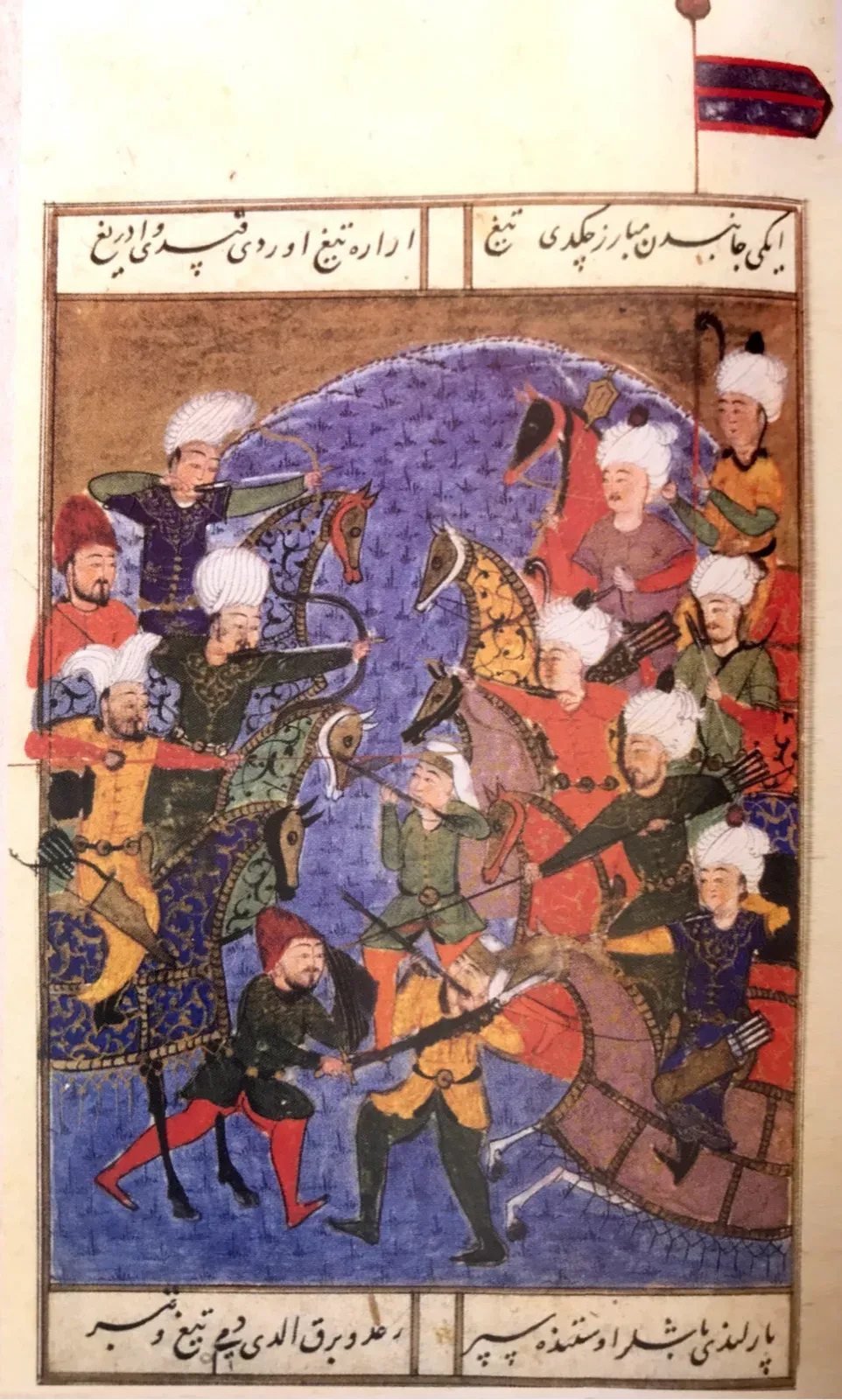
When the two hosts collided on the morning of 24 August at Marj Dabiq, the contrast in military doctrine was lethal. The Mamluk cavalry opened the battle with a series of thunderous, heroic charges. On the wings, their elite horsemen fought with astonishing bravery, smashing into the Ottoman Sipahis and pushing them back across the dust. For a brief hour, the Mamluks believed their chivalric virtue would sweep the field.
Then the charges hit the Ottoman centre.
Against the chained wagons, the Mamluk horses balked. Behind the barricades, the Janissaries stood shoulder to shoulder, firing systematic, continuous volleys of lead, while Ottoman field guns tore into the packed ranks of cavalry with canister shot. Men and horses were shredded before they could come within sword-length of a defender. It was not a duel; it was an execution.
To military obsolescence, Selim added political betrayal. The Ottoman sultan was never above bribing what he could not shoot. Khay’r Baig, the Mamluk governor of Aleppo commanding the army’s left wing, had secretly agreed to defect in exchange for Ottoman patronage. As the carnage in the centre worsened, Khay’r Baig ordered his division to abandon the field, spreading a panicked rumour through the ranks that Sultan al-Ghawri was already dead.
The Mamluk army dissolved into an uncontrollable rout. Sultan al-Ghawri, watching his two-hundred-year-old empire vanish in smoke and panic, suffered a stroke or heart attack in the saddle. He slid from his horse into the dirt, where his body was trampled by his own fleeing soldiers and never identified.
The strategic consequences of Marj Dabiq were staggering. In a single afternoon, the Mamluk defence of Syria evaporated. Aleppo surrendered its keys to Selim without firing a shot; Damascus, Beirut, and Jerusalem opened their gates within weeks. Five months later, Selim marched his army across the Sinai desert, crushed the remaining Mamluk forces outside Cairo at Ridaniya, and hanged the last Mamluk sultan from the city’s gates.
By conquering Egypt, Selim transformed the Ottoman Empire from a regional marcher state into a global superpower. Egypt was not just land; it was the financial beating heart of the eastern Mediterranean. It was the agricultural granary that fed Constantinople, the nexus of the lucrative spice routes from India, and the home of the Abbasid shadow caliphate. Selim claimed the title of Khadim al-Haramayn - the Servant of the Two Holy Sanctuaries of Mecca and Medina - and assumed spiritual leadership of the entire Sunni Muslim world.
When Selim died suddenly in 1520 at the age of forty-nine, having succumbed to a skin infection after barely eight years on the throne, he left his twenty-five-year-old son Suleiman the easiest inheritance in dynastic history. Because Selim had systematically murdered his own brothers and nephews to prevent succession wars, Suleiman took the throne without a single rival to challenge him. He inherited a professional army with unmatched firepower, safe southern and eastern frontiers, and a treasury so swollen with Egyptian gold that it funded half a century of European conquest.
Suleiman went on to earn his title of “the Magnificent” by besieging Vienna and building sublime domed mosques, basking in the praise of European ambassadors and Ottoman chroniclers alike. But the hard, bloody work of empire had already been done. History may prefer to remember the poet on the throne in his golden robes, but the invoice for his splendour was signed in gunpowder and blood at Marj Dabiq.