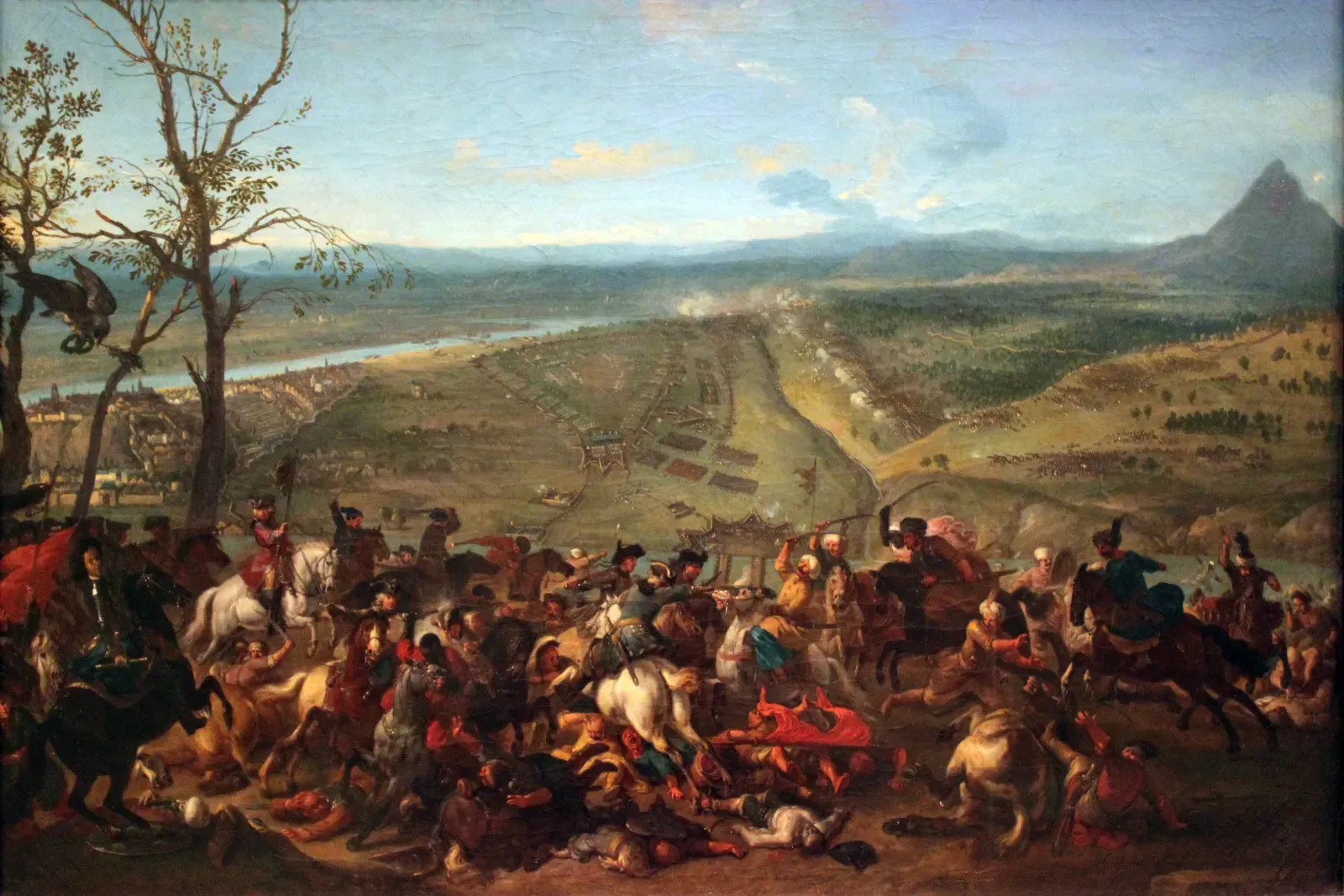
On the morning of 16 August 1717, Prince Eugene of Savoy found himself trapped in the single worst tactical position a general can engineer for himself: besieging an impregnable fortress while completely surrounded by a relief army more than twice his size. Inside Belgrade sat a stubborn Ottoman garrison of thirty thousand men behind formidable stone bastions. Outside his siege lines, occupying the ring of high ground on the hills of Vračar, stood Grand Vizier Hacı Halil Pasha with at least one hundred and fifty thousand Ottoman soldiers, looking down into the Austrian trenches like spectators in an amphitheatre. Pinned between the walls and the heights, with the Danube and the Sava blocking his retreat, Eugene’s imperial army was melting away from dysentery, malaria, and relentless bombardment. He had only two realistic options: surrender the siege in humiliation or attack blind uphill against impossible odds.
He chose the fog. At one o’clock in the morning, under the cover of a thick, impenetrable mist rolling off the Danube, Eugene marched fifty thousand men out of their fortified camp and straight into the Ottoman lines. It was one of the most audacious gambles in the history of European warfare, and it delivered one of the most decisive tactical triumphs of the eighteenth century. Yet when I look at the wreckage of that morning and the two decades of Austrian rule that followed, what strikes me most is not the tactical genius of the assault, but how little lasting reality imperial Austria managed to build on top of it.
To understand why Eugene was willing to wager his entire army on a night assault in the mist, you have to understand what Belgrade meant to the map of Europe. For centuries, the fortress at the confluence of the Sava and the Danube was not merely a city; it was the hinge of the continent. The Ottomans called it Darülcihad - the House of the Holy War - and the Gate of the Holy Roman Empire. When Suleiman the Magnificent took it in 1521, he cracked open the Hungarian plains and cleared the road to Vienna. For two hundred years, whoever held Belgrade held the master key to the Balkans. If the Habsburgs wanted security on their southern frontier, they could not simply defend the Austrian borderlands; they had to push the Turks back beyond the Danube and lock the gate behind them.
The Austrians had seized Belgrade once before, in 1688 during the Great Turkish War, only to lose it back two years later when King Louis XIV invaded the Rhineland and forced Vienna to fight on two fronts. That failure lingered like an open wound in the imperial war council. When Sultan Ahmed III declared war on Venice in 1714 and threatened to roll back Christian gains across the Mediterranean, Emperor Charles VI intervened, putting Eugene in command of the imperial forces. Eugene, already the most celebrated commander in Europe after his victories at Blenheim, Turin, and Petrovaradin, knew that half-measures would solve nothing. Taking Belgrade was the only objective that mattered.
He arrived before the fortress in June 1717 with roughly seventy thousand imperial troops, including German, Austrian, and Hungarian contingents. Rather than attempting a reckless direct assault against the citadel, Eugene set his men to digging. He constructed two vast lines of earthworks: a line of circumvallation facing inward to choke off the garrison, and a line of contravallation facing outward to guard against any relief force. For six weeks, the imperial siege artillery pounded Belgrade into rubble, eventually scoring a direct mortar hit on the fortress’s main powder magazine that obliterated large swathes of the city and killed thousands of defenders in a single deafening explosion.
Yet just as Belgrade seemed ready to crack, the tables turned with brutal speed. In late July, Grand Vizier Hacı Halil Pasha appeared on the horizon at the head of a relief army that dwarfed the imperial force. Instead of launching a frontal assault against Eugene’s outer ramparts, the Grand Vizier did something far more dangerous: he occupied the heights surrounding the Austrian lines, dug in his own heavy artillery, and began methodically bombarding Eugene’s camp from above. By early August, the besiegers were the ones under siege. Temperatures soared, Danube fever and dysentery swept the cramped Austrian tents, and Eugene himself fell gravely ill. His effective fighting strength plummeted by thousands each week. In a few more weeks of passive containment, the Austrian army would cease to exist as a functional fighting force.
Eugene understood the arithmetic of survival better than anyone. Waiting was suicide; a negotiated retreat meant abandoning his siege train and inviting the Ottoman cavalry to slaughter his rearguard on the riverbanks. The only way out was forward. On the night of 15 August, he issued secret orders for a general assault to begin before dawn. The plan was terrifyingly risky: imperial columns would advance in total silence up the steep slopes, assault the Ottoman trenches, and break the enemy line before the Ottoman numerical superiority could be brought to bear.
When the imperial troops moved out past midnight on 16 August, a dense river fog enveloped the battlefield, so thick that soldiers could barely see their own bayonets. What was meant to be a coordinated advance quickly dissolved into confusion. Units lost contact in the dark, marching into ravines or stumbling directly into enemy outposts. On the right wing, an imperial brigade wandered blindly into a gap between Ottoman trenches and found itself nearly surrounded by Janissaries. Musket flashes lit up the mist like lightning, and for several frantic hours, the battle threatened to turn into a slaughter of the attackers.
The turning point came around eight in the morning, when the rising sun and a sudden breeze tore the veil of fog from the plateau. With the mist gone, Eugene, surveying the field on horseback despite his fever, instantly spotted the fatal flaw in the Ottoman disposition: in their rush to envelop the isolated Austrian right wing, the Ottomans had left a wide opening in their centre. Eugene wasted not a second. Gathering his cavalry reserve - heavy cuirassiers clad in blackened steel armour - he led them straight into the rupture.
The shock was devastating. The Austrian heavy cavalry smashed through the Ottoman lines, rolling up the flanks of the Janissaries and creating instant pandemonium. Seeing their centre broken and the imperial infantry closing in behind the cavalry, the Ottoman relief army fractured. Panic spread through Halil Pasha’s ranks with terrifying speed. Within two hours, what had been an overwhelming host of one hundred and fifty thousand men dissolved into a headlong flight towards Niš. The Grand Vizier abandoned his entire camp, leaving behind over one hundred and thirty cannon, immense stores of gunpowder, baggage trains, and the imperial war chest. The relief army was utterly destroyed.
Inside the fortress, the Ottoman garrison watched the catastrophe unfold in helpless disbelief. With their relief army vanished into thin air, their powder magazine destroyed, and Eugene’s victorious guns now turning back towards the citadel walls, Mustafa Pasha had no cards left to play. On 18 August, the garrison asked for terms, and within days, the Austrian army marched through the gates of Belgrade. Across Catholic Europe, church bells rang and Te Deums were sung. In Vienna, Eugene was hailed as the saviour of Christendom; a popular soldier’s ballad, Prinz Eugen, der edle Ritter, was composed to immortalise the morning he broke the Turks in the fog.
The Treaty of Passarowitz, signed the following year in 1718, formalised the scale of the triumph. The Habsburg Monarchy reached its greatest territorial extent in south-eastern Europe, absorbing not only Belgrade and northern Serbia, but also the Banat of Temeswar, Little Wallachia, and swathes of northern Bosnia. On paper, it looked like the dawn of a new Austrian empire in the Balkans.
Yet paper has a way of flattering imperial conquerors. For the people who actually lived between the Sava and the Morava - the Serbian population that had fought in Eugene’s ranks and endured centuries of Ottoman vassalage - the change of masters offered no real emancipation. Vienna established the “Kingdom of Serbia” not as a self-governing homeland, but as a heavily militarised border province run by German administrators and garrisoned by imperial regiments. The Habsburgs taxed the peasantry aggressively, imposed Catholic administrative control, and treated northern Serbia primarily as a fortress buffer against future Turkish incursions. The Serbs had exchanged an Ottoman pasha for an Austrian military governor.
Worse still, the empire proved incapable of defending what Eugene had won with such brilliance. When Eugene died in 1736, he took Austria’s military competence with him to the grave. Just three years later, during the disastrous Austro-Russian-Turkish War of 1737–1739, an incompetent Austrian command was routed at Grocka. Under the shameful Treaty of Belgrade in 1739, Vienna handed the fortress and northern Serbia right back to the Sultan without the Ottomans even having to breach the walls. Twenty-two years of Austrian rule vanished overnight, and the border retreated to the Danube, where it would remain frozen for another century.
The lesson of 16 August 1717 is not that military genius can redraw maps; it is that maps redrawn purely by the sword rarely hold without political root. Prince Eugene’s charge through the morning mist was a masterpiece of tactical audacity, a moment when one man’s nerve turned certain disaster into total victory. But the empire he served treated Belgrade as an outpost to be garrisoned rather than a country to be built. Serbian independence would not arrive as a gift from Austrian emperors or European coalitions. It would have to wait another century, forged through blood and sacrifice by the Serbs themselves in the uprisings of 1804 and 1815. Eugene won the fortress in the fog, but the future of the Balkans was never his to keep.