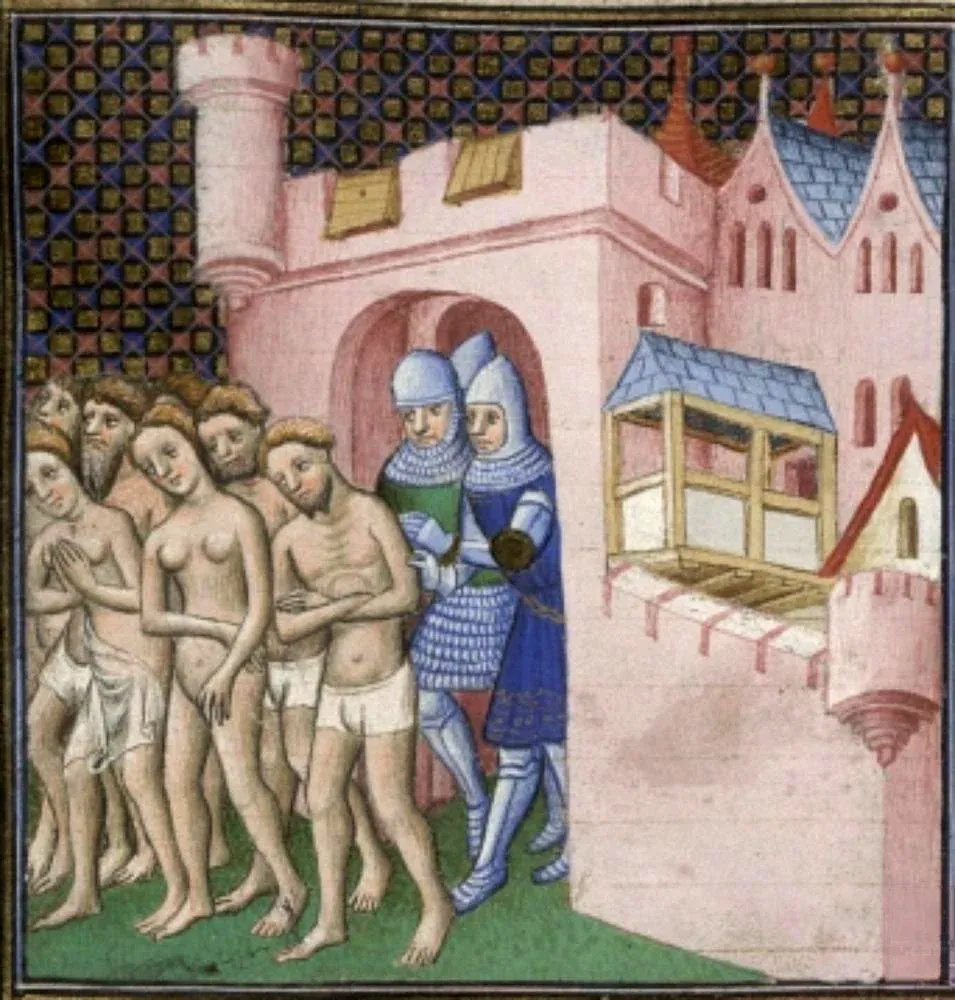
Anyone who has walked the walls of Carcassonne knows the first thing about the place: it does not look conquerable. Fifty-two towers, a double ring of ramparts, a citadel perched above the Aude with sightlines in every direction. The medieval city was weaker than the one Viollet-le-Duc rebuilt for tourists in the nineteenth century, but not by much. In August 1209, an army of northern French crusaders sat down in front of it and discovered what besiegers usually discover - that the fastest way through a fortress is rarely the wall.
Three weeks earlier, that same army had taken Béziers, and “taken” is doing a lot of work in that sentence. The city refused to surrender its Cathar heretics, the crusaders broke in, and the killing did not stop at the heretics. Contemporary estimates run to fifteen or twenty thousand dead, and while the numbers are certainly inflated, nobody disputes the essential fact that the town was massacred wholesale, Catholics and heretics together. The papal legate Arnaud Amalric is supposed to have settled the theological difficulty of telling the two apart with the instruction “Kill them all; God will know his own.” He probably never said it - the line appears in a chronicle written years later - but the fact that contemporaries found it plausible tells you what Béziers was. Word of it travelled faster than the crusader army did. Town after town emptied or submitted as the army moved west. Béziers had done the crusaders’ propaganda work for them, in blood.
Carcassonne was a different proposition. This was the seat of Viscount Raymond-Roger Trencavel, twenty-four years old, lord of Béziers, Carcassonne, Albi, and Razès, and the most important secular protector the Cathars had. The Cathars - the “Good Men” who preached that the material world was the work of a fallen god, that the Church of Rome was corrupt beyond redemption, and that salvation lay in a stark dualist faith - had thrived in the Languedoc precisely because men like Trencavel declined to persecute them. Pope Innocent III had spent a decade trying to get the southern nobility to root out the heresy, and had received a decade of polite shrugs. When his legate Pierre de Castelnau was murdered in 1208, Innocent called the crusade: the first one ever preached not against Muslims in the East but against Christians inside Europe, with the full indulgence of the Holy Land campaigns on offer for forty days of service. Forty days to kill your neighbours and save your soul. The north of France signed up in thousands.
Trencavel tried to bargain before the siege and got nowhere - the legate’s terms amounted to abject submission - so he returned to his city and prepared to hold it. The walls were strong, the garrison loyal, the suburbs full of refugees who had fled before the crusader advance. The weakness was water. The city sits above the river, and its wells could not support the swollen population through an August siege. When the crusaders seized the access points to the Aude and the wells began to fail, arithmetic did what no battering ram could have managed. The besiegers barely had to fight. They waited, in their tens of thousands, while dysentery and thirst did the work inside the towers.
What happened next has an ugly little footnote that I find more telling than the surrender itself. On 15 August 1209, the Feast of the Assumption, Trencavel accepted a safe-conduct to negotiate in the crusader camp. Once there, he was seized. The safe-conduct, it turned out, was a courtesy extended by men who did not consider themselves bound to honour it towards a protector of heretics. With their viscount in chains, the citizens of Carcassonne had nothing left to negotiate with. The city capitulated, and its inhabitants - every last one, Catholic and Cathar alike - were expelled with the clothes on their backs and nothing else. Peter of les Vaux-de-Cernay, the Cistercian chronicler who marched with the army and adored it, records that the refugees left in their shifts. The crusaders inherited a walled city, fully furnished, and a viscount who died in his own dungeon three months later, officially of dysentery. Whether you believe the official cause probably depends on how charitable you feel towards men who had just sacked Béziers.
The spoils needed an owner. The barons of the crusade offered the Trencavel inheritance to one northern lord after another, and one after another they declined - the south was a hornet’s nest, and ruling it looked like a life sentence of sieges. Finally the offer landed on a minor baron from the Île-de-France, a man with more ambition than land: Simon de Montfort. He accepted. It was the making of him, the ruin of the Trencavels, and, in a sense, the birth certificate of modern France.
That last claim is not hyperbole, and it is why I think the fall of Carcassonne matters far beyond its siege lines. The Languedoc in 1209 was not really France. It was a wealthy, Mediterranean, culturally distinct world - the world of the troubadours, of Occitan rather than French, of feudal ties that ran south to the Crown of Aragon rather than north to Paris. King Peter II of Aragon was Trencavel’s nominal overlord, and the crusade exposed how little that protection was worth; Peter watched Carcassonne fall, prevaricated, and four years later died on the field at Muret trying, too late, to stop de Montfort. Aragonese ambitions north of the Pyrenees died with him. The crusade ground on for another twenty years, through revolts, mass burnings of Cathar perfecti, and de Montfort’s own death at the siege of Toulouse, until the Treaty of Paris in 1229 folded the exhausted south into the Capetian royal domain. The France we know - one kingdom, one crown, Paris at the centre - is a direct descendant of that transaction.
The Cathars, for their part, lost their shield and never recovered it. The lesson Rome drew from the crusade was that armies were a blunt and unreliable instrument against heresy; far better to institutionalise the hunt. The papal Inquisition was born out of the Albigensian failure, and it finished the work the crusaders started - patiently, judicially, bonfire by bonfire, until the last Cathar stronghold at Montségur fell in 1244 and the last known perfectus was burned in 1321. A crusade that began with a massacre ended by inventing a bureaucracy of persecution that Europe would find uses for, again and again, for centuries.
What stays with me about 15 August 1209 is the gap between the stated cause and the actual result. Innocent III preached a war for the purity of the faith. What the war delivered was a murdered viscount, a dispossessed population, a northern baron enriched beyond imagining, a rival kingdom ejected from the south, and a French crown that swallowed a civilisation. The heresy it targeted was dead within a century, but one suspects the Capetians would have taken the deal even if every Cathar in the Languedoc had survived. Carcassonne’s walls were never breached. They did not need to be. The crusade walked in through an open gate, and France walked in behind it - and never left.