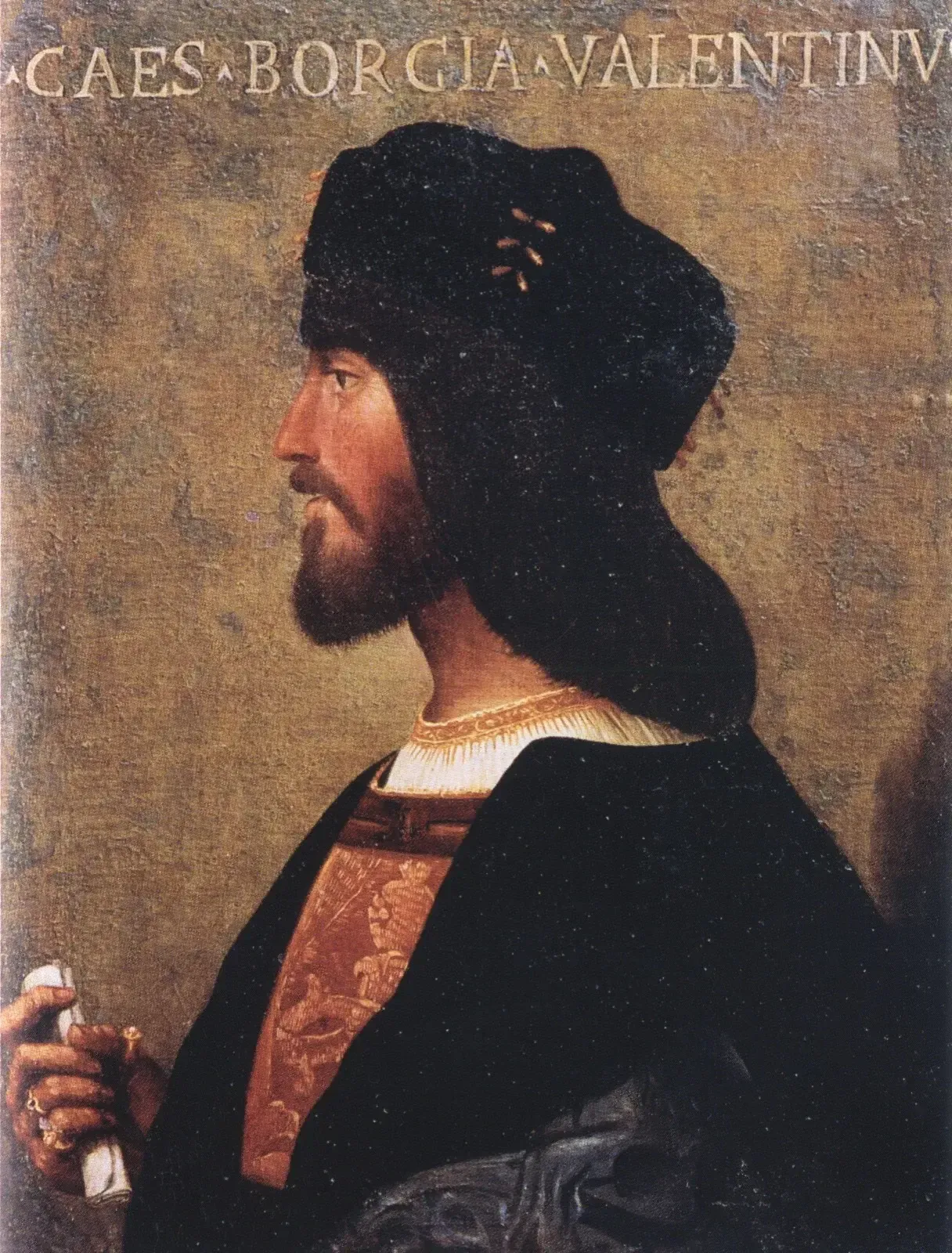
On 17 August 1498, a twenty-two-year-old Prince of the Church stood before the Sacred College in Rome and performed an act without precedent in Catholic history. Cesare Borgia, Cardinal-Deacon of Santa Maria Nuova, Archbishop of Valencia, and favourite son of Pope Alexander VI, formally surrendered his red hat. He explained, with an entirely straight face, that from his earliest youth he had felt drawn to the secular life rather than the church. The cardinals, who knew perfectly well that their young colleague spent his afternoons hunting wild boar, seducing noblewomen, and slaying bulls in public arenas, voted unanimously to let him go. Later that same afternoon, King Louis XII of France signed letters patent creating the former cardinal Duke of Valentinois. It was the cleanest, most cynical transaction the Renaissance ever staged: a papal divorce delivered in exchange for a French duchy, a royal bride, and an army.
I have always admired the sheer transparency of the transaction. Pope Alexander VI needed a sovereign realm for his bastard son; King Louis XII needed a papal annulment to discard his childless wife, Joan of Valois, so he could marry the wealthy widow Anne of Brittany and secure her duchy for the French crown. Rome possessed the theological stamp, and Paris had the soldiers. The swap was so brazen it discarded every pious fiction Christendom used to disguise its dynastic ambitions. By nightfall on 17 August, Cesare had ceased to be a reluctant priest and had become Il Valentino - the Duke of Valentinois - backed by French heavy cavalry, a royal pension, and papal blessing to carve himself a kingdom out of central Italy.
Cesare had never wanted the altar. His father, Rodrigo Borgia, treated the Roman Church not as a spiritual sanctuary, but as a family investment bank. Rodrigo had assigned the family’s secular military command to his eldest son, Juan, Duke of Gandia, while forcing the more dangerous Cesare into holy orders. At eighteen, Cesare was an archbishop; at nineteen, a cardinal. But the red silk chafed against a man whose instincts were purely predatory. The impasse dissolved on a June night in 1497, when Juan was ambushed in Rome, his throat slit and his body dumped into the Tiber with thirty gold ducats still untouched in his purse. The murderer was never officially caught, but Rome had little doubt about who benefited from the corpse. With his brother at the bottom of the river, Cesare was no longer the spare cleric. He was the sole heir to the Borgia dynasty, and he had no intention of wasting his life hearing confessions.
In October 1498, Cesare sailed for France with an entourage of breathtaking vulgarity, riding into Chinon draped in red satin and pearls, his horse shod with silver shoes tacked on loosely so they would fall into the mud for peasants to fight over. In his pocket was the papal bull granting Louis XII his divorce. In return, Cesare collected his ducal coronet and the hand of Charlotte d’Albret, sister to the King of Navarre. When he returned to Italy the following year, he brought three hundred French lances and four thousand Swiss mercenaries with him.
What followed was a masterclass in territorial conquest. Central Italy was a fractured patchwork of petty tyrants and squabbling warlords who ruled the cities of the Romagna like extortion rackets. Cesare did not negotiate; he annihilated them. Imola fell first, followed by Forlì, where Caterina Sforza mounted a ferocious defence before being captured. Rimini, Pesaro, and Faenza fell in turn. Cesare understood, long before most European rulers, that reliance on hired condottieri was an invitation to treason. He recruited his own citizen militias, established central courts to enforce consistent law, and imposed order on provinces that had known only feuds and banditry for generations.
His methods were monstrous, but they were executed with surgical precision. To pacify the Romagna, Cesare unleashed his Spanish lieutenant, Ramiro de Lorqua, a man of terrifying cruelty. Once Ramiro had terrorised the province into submission, Cesare dealt with the public outrage by having Ramiro arrested, chopped in two, and laid out on the central piazza of Cesena on Christmas morning, 1502, with a wooden block and a bloody knife beside him. The spectacle left the populace satisfied and terrified in equal measure. The cruelty had been outsourced to the subordinate; the justice belonged to the prince.
Watching this bloodshed was a young Florentine diplomat named Niccolò Machiavelli. Florence had sent Machiavelli to Cesare’s travelling camp to monitor the conqueror menacing the republic’s borders. Instead of recoiling in disgust, Machiavelli was mesmerised. For a diplomat whose own republic was perpetually paralysed by committees and moral posturing, Cesare was a revelation. He was the living embodiment of virtù - not virtue in the Christian sense of piety, but the Roman quality of vigour, audacity, and ruthless command over fortune.
When Cesare suspected his mercenary captains of plotting against him, he did not fight them in the field. He invited them to a reconciliation banquet at Senigallia in December 1502, disarmed their escorts, and had them strangled in their chairs before dawn. Machiavelli described the trap with the clinical admiration of an anatomist inspecting a flawless specimen. When he wrote The Prince a decade later in exile, Cesare was the book’s beating heart. Machiavelli presented him as the ultimate archetype for any ruler: a prince who knew it is far safer to be feared than loved, and who understood that when cruelty is necessary, it must be struck swiftly and without remorse.
Yet Cesare’s political creation had one fatal, structural flaw: it rested entirely on his father’s heartbeat. Cesare had conquered the Romagna with the authority and treasury of the papacy. He believed he had planned for every contingency, including Alexander VI’s death. But in August 1503, both pope and son were struck down simultaneously by violent summer malaria. While the seventy-two-year-old Pope died in agony, Cesare lay delirious in the Castel Sant’Angelo, his skin peeling and lungs failing, unable to mount a horse during the crucial days of the papal conclave.
In Renaissance Italy, three weeks of paralysis was fatal. The Romagna fractured immediately, and the cardinals elected Giuliano della Rovere - Pope Julius II - the Borgias’ mortal enemy. In a catastrophic lapse of judgement, Cesare trusted Julius’s promise of protection in exchange for the Spanish cardinals’ votes. Julius took the tiara and promptly threw Cesare into prison, stripping him of his fortresses. As Machiavelli observed, the Duke had committed his one unforgivable error: believing that an enemy could ever forgive a past injury.
The rest of Cesare’s life was a rapid, unravelling coda. Shipped to Spain as a prisoner, he escaped down a castle rope and fled to Navarre. By then, his legendary physical beauty had been destroyed by syphilis - the “French disease” - leaving his face so disfigured that he wore a black leather half-mask in public. On 12 March 1507, during a minor skirmish at the siege of Viana, he rode alone into an enemy ambush, charging ahead in a frenzy of reckless vanity. The enemy stripped his corpse and left his naked, mutilated body in the dirt. He was thirty-one years old.
The irony of Cesare Borgia’s life is that the decision that made him immortal was the very one that guaranteed his ruin. On 17 August 1498, when he tossed his cardinal’s hat onto the Vatican floor, he believed he was casting off religious constraints to seize the tangible power of the sword. He saw through the hypocrisy of his age and played the game of power with terrifying brilliance. But his sword was rented with papal coin, and his state died with his father. Cesare ended as a disfigured mercenary in a Basque ditch, yet the cold logic of his career outlived his empire. Five centuries later, every ambitious ruler still reads The Prince, learning statecraft from a failed cardinal who gave up heaven for a French duchy and a kingdom made of sand.