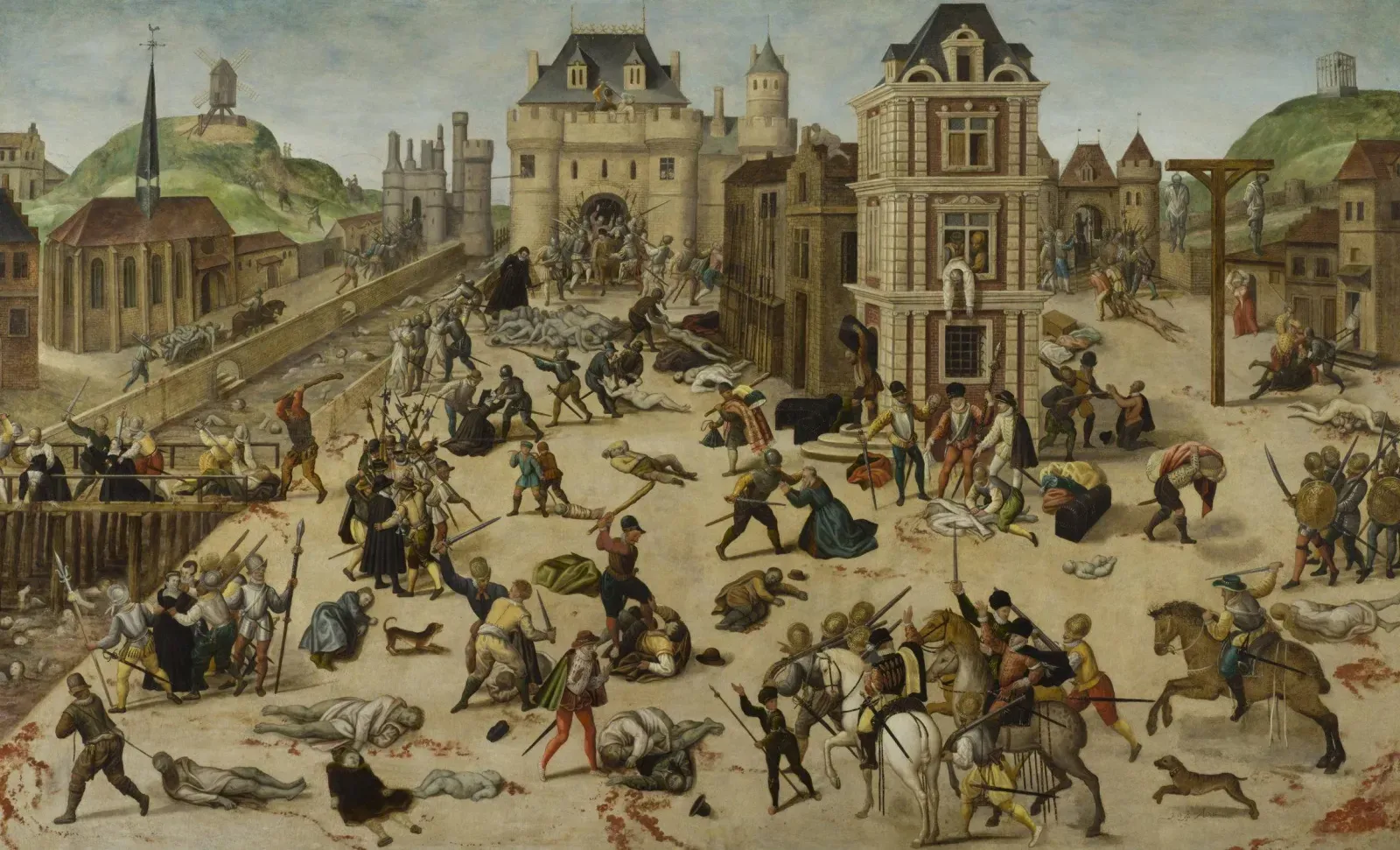
On the night of 23 August 1572, the bells of Saint-Germain-l’Auxerrois tolled across Paris to announce a butchery. Within hours, the French capital became an open-air slaughterhouse. Bands of Catholic burghers, royal guards, and armed militia dragged Protestant men, women, and children from their beds, slit their throats in front of their neighbours, and hurled thousands of corpses into the Seine. For centuries, popular myth has treated the St. Bartholomew’s Day massacre as a masterpiece of cold, Machiavellian premeditation - the dark culmination of a long-nursed Catholic conspiracy orchestrated by Catherine de’ Medici to wipe out French Protestantism in a single blow.
I have always found that grand conspiracy theory unconvincing. The reality was far more pathetic. The massacre was not a stroke of villainous genius; it was an administrative panic. It was the desperate, botched cover-up of a failed political assassination, cooked up by a terrified royal council that lost control of its own capital and decided to drown its incompetence in blood.
The disaster began six days earlier as an exercise in royal public relations. On 18 August, Paris hosted the grandest wedding of the decade: Margaret of Valois, the Catholic sister of King Charles IX, married Henry of Navarre, the teenage leader of the Huguenot nobility. The union was meant to seal the fragile Peace of Saint-Germain-en-Laye and finally end a decade of savage religious civil war. Paris was suffocating in late-summer heat, swollen with tens of thousands of impoverished Catholic citizens who detested Protestants, and suddenly filled with hundreds of swaggering Huguenot nobles dressed in Italian velvet.
The tension was absurdly visible at the altar. Because Henry of Navarre was an unrepentant Calvinist, he refused to set foot inside Notre-Dame for Mass. The ceremony took place on an enormous wooden platform erected on the parvis outside the cathedral doors. When the blessing ended, Margaret walked inside to hear the Catholic service, while her new groom stood outside in the sun, surrounded by his armed entourage. It was an awkward compromise, but it held. For four days, Catholics and Protestants danced, jousted, and drank together in the Louvre.
The peace detonated on Friday, 22 August. As Admiral Gaspard de Coligny - the military elder statesman of the Huguenots - walked back to his lodgings from a council meeting at the Louvre, an assassin named Maurevert fired an arquebus from a curtained window. The bullet should have killed him. Instead, Coligny happened to bend down to adjust his shoe; the shot merely severed an index finger and shattered his left elbow.
The botched sniper shot broke the kingdom. Coligny was not just an ordinary general; he had become a surrogate father and chief counsellor to the neurotic twenty-two-year-old Charles IX, urging the young king to unite France by invading the Spanish Netherlands. The Guise family, leaders of the ultra-Catholic faction, despised Coligny and blamed him for the murder of Duke Francis of Guise nine years earlier. Catherine de’ Medici, terrified of Coligny’s influence over her son and fearful of an unwinnable war with Spain, almost certainly approved the assassination attempt.
When the hit failed, the Louvre descended into hysteria. Hundreds of furious Huguenot gentlemen gathered around Coligny’s bedside on the Rue de Béthizy, openly demanding vengeance against the Guises and threatening to take justice into their own hands. Charles IX, genuinely fond of Coligny and unaware of his mother’s complicity, promised a relentless investigation. If the magistrates caught Maurevert, the paper trail would lead directly to the Guises and from there into the Queen Mother’s private apartments.
On the evening of 23 August, Catherine, her younger son Henry of Anjou, and their closest Italian advisers cornered the fragile king in his private chambers. They presented Charles with a terrifying fabrication: the Huguenots were preparing an armed coup that very night to seize the palace, murder the royal family, and install Coligny in power. Their solution was simple and brutal. The Crown should strike first by executing Coligny and two dozen Protestant commanders sleeping in lodgings across Paris.
Charles IX, prone to fits of violent rage and terrified of losing his throne, cracked under the pressure. He reportedly screamed at his mother: “Kill them then! Kill them all, that not one be left to reproach me!”
In the early hours of 24 August - the feast day of Saint Bartholomew - Henry, Duke of Guise rode to Coligny’s lodgings with a company of Swiss mercenaries. A German soldier named Besme ran Coligny through with a boar spear, slashed his face, and tossed his body through the window into the courtyard below. Guise wiped the blood from the corpse’s cheek with a handkerchief to confirm the kill, kicked the dead admiral in the face, and shouted that the King commanded it. Coligny’s head was severed and sent to Rome; his mutilated torso was dragged through the gutter by street children and hanged by the heels at Montfaucon.
That was where the royal plan was supposed to end: a surgical decapitation of the Huguenot leadership. But the Crown had fundamentally misunderstood the city it ruled. When the bells of Saint-Germain-l’Auxerrois sounded the alarm and the King’s guards began killing nobles inside the Louvre itself, the Catholic population of Paris assumed they had been granted a royal licence for holy war.
Decades of sectarian hatred, compounded by bread shortages and religious hysteria, exploded across the city. Catholic shopkeepers murdered Protestant competitors; landlords slaughtered tenants to seize their goods; students killed their professors. Over the next three days, mobs broke into every house marked with a white cross, bayoneted infants, drowned screaming families in the Seine, and stripped victims naked on the cobbles. When the royal council realised what it had unleashed and sent out heralds ordering the slaughter to stop, the militia laughed in their faces.
The killing did not stay in Paris. Over the following six weeks, the fever spread down the river valleys to Orléans, Lyon, Rouen, Bourges, Bordeaux, and Toulouse. Provincial magistrates received garbled verbal instructions and stood by while local mobs emptied prisons and threw Protestant corpses into communal lime pits. By the time the madness subsided in October, between ten thousand and thirty thousand people had been butchered across France.
The geopolitical reaction was surreal. In Rome, Pope Gregory XIII was so delighted that he sang a Te Deum, ordered celebratory cannon fire from the Castel Sant’Angelo, and commissioned Giorgio Vasari to paint frescoes commemorating the slaughter. In Madrid, King Philip II reportedly laughed out loud - an event so rare his courtiers noted it with shock. Both men assumed Catholic France had finally crushed the Protestant heresy forever.
They were spectacularly mistaken. Murdering your moderate negotiating partners does not win a civil war; it simply eliminates the only people willing to talk to you. The St. Bartholomew’s Day massacre destroyed royal moral authority, convinced French Protestants that Valois treaties were worthless, and radicalised Calvinist political thought across Europe. Writers like François Hotman and Philippe Duplessis-Mornay forged the theory of justifiable resistance, arguing that monarchs who slaughter their own subjects are tyrants whom citizens have a moral right to depose.
Instead of ending the conflict, the massacre guaranteed another twenty-six years of relentless civil war. The Protestant movement retreated into heavily fortified southwestern enclaves like La Rochelle and fought with suicidal ferocity. Henry of Navarre survived the carnage in the Louvre only by kneeling before Charles IX and feigning conversion to Catholicism; four years later he escaped Paris, recanted, and took command of the Huguenot armies. He would outlive Charles IX, Henry III, the Guises, and the entire Valois dynasty, eventually taking the crown as Henry IV and granting Protestants legal toleration under the Edict of Nantes in 1598 - before dying decades later in the assassination of Henry IV.
When the bells rang above the Louvre on 23 August 1572, the rulers of France believed they were carrying out a tidy political purge to save their own skins. What they actually did was turn their kingdom into an abattoir, surrender their sovereignty to a feral mob, and sign the death warrant of their own dynasty.