On 22 August 1864, in a wood-panelled room inside the Geneva Town Hall, diplomats from twelve European states signed a document promising they would no longer shoot each other’s doctors. It took them barely two weeks of polite conversation and ten concise articles of text. The agreement, officially titled the Convention for the Amelioration of the Condition of the Wounded in Armies in the Field, is remembered today as the foundation stone of international humanitarian law. It gave the world the red cross on a white background, established the legal neutrality of field ambulances, and declared that a soldier lying in the mud with his guts torn open was no longer an enemy combatant, but a human being entitled to medical care.
It sounds like a sudden triumph of Christian charity or Enlightenment philosophy. It was neither. The First Geneva Convention did not come from the moral awakening of European monarchs or the high-minded benevolence of their general staffs. It was born because a Swiss businessman went looking for a water concession, stumbled into a slaughterhouse, and realised that nineteenth-century firepower had outrun the state’s capacity to clean up after itself.
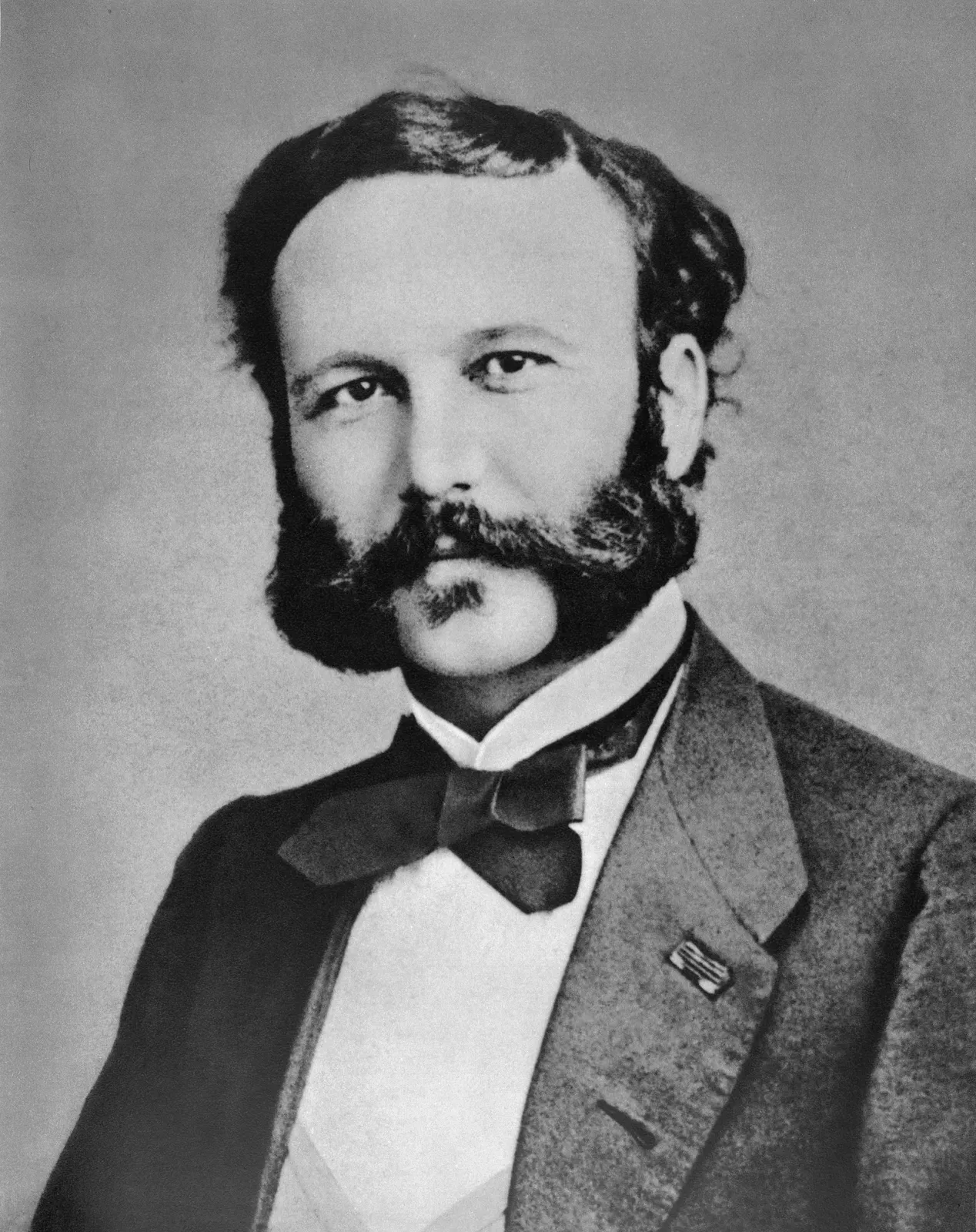
That businessman was Henry Dunant. In June 1859, Dunant was a thirty-one-year-old entrepreneur travelling through northern Italy in a crisp white linen suit. He was not there on a charitable mission; he was desperately chasing Napoleon III across Lombardy to secure water and land rights for a hydraulic grain-milling venture in French-occupied Algeria. Instead of catching the Emperor in a quiet tent, Dunant arrived on 24 June at the immediate aftermath of the Battle of Solferino.
Solferino was the bloodiest single-day clash Europe had witnessed since Waterloo. Roughly three hundred thousand French, Sardinian, and Austrian troops collided across a fifteen-kilometre front. By sunset, forty thousand men lay dead or wounded under a merciless summer sun. The military medical services on both sides were practically non-existent. The French army had brought more veterinarians for its cavalry horses than field surgeons for its infantry battalions. Thousands of young men lay for three days in the dust with shattered femur bones and gangrenous wounds, screaming for water while local peasants stripped the boots from the corpses of their comrades.
Dunant was horrified, but he did something practical. He put aside his business prospectus, recruited local women in the nearby town of Castiglione delle Stiviere, and turned the Chiesa Maggiore into a makeshift field hospital. He bought bandages, lemons, and tobacco with his own money, and insisted that the volunteers treat Austrian and French casualties without distinction, repeating a simple slogan to the exhausted townspeople: “Tutti fratelli” - all are brothers.
When Dunant returned to Geneva, he could not shake what he had witnessed. He abandoned his Algerian milling business to bankruptcy and spent two years writing A Memory of Solferino, published in 1862 at his own expense. He sent copies to kings, prime ministers, and military commanders across Europe. His thesis contained two radical proposals: every country should establish peacetime volunteer relief societies to assist army medical corps, and states should sign a binding treaty recognising field medics, ambulances, and wounded soldiers as neutral non-combatants on the battlefield.
A moral appeal rarely persuades a war ministry on sentiment alone. Dunant’s stroke of luck was teaming up with Gustave Moynier, a hard-nosed Genevan lawyer with an instinct for institutional bureaucracy, and General Guillaume-Henri Dufour, the respected commander who had ended Switzerland’s Sonderbund War with minimal bloodshed. Together with two local physicians, they formed the Committee of Five - the embryonic International Committee of the Red Cross. In August 1864, the Swiss Federal Council invited sixteen governments to Geneva. Twelve signed the final text on 22 August, including France, Prussia, Spain, Italy, the Netherlands, and Switzerland.
Why did hard-bitten military powers sign away their freedom of action so quickly? Because by the 1860s, war had become an industrial management problem. The introduction of rifled muskets, conical Minié bullets, and breech-loading artillery had transformed combat into an abattoir. As the conclusion of the American Civil War was proving across the Atlantic at that very moment, modern armies were producing casualties at a rate that threatened to collapse their own logistics. An army whose wounded were left to rot in trenches was an army plagued by disease, desertion, and mutiny. Granting neutrality to medical staff cost the high commands nothing in combat effectiveness, while protecting their own trained doctors and preserving expensive manpower.
The treaty was a model of Swiss efficiency. In ten short articles, it established that military ambulances and hospitals were neutral so long as they housed the wounded; that medical personnel, chaplains, and stretcher-bearers could not be taken prisoner; that civilians who took in wounded soldiers would be rewarded with tax relief and exempted from military billeting; and that wounded soldiers would be cared for regardless of nationality. To identify this protected zone, the signatories adopted an emblem that merely inverted the Swiss federal flag: a red cross on a field of white.
I have always looked on the Geneva Convention with deep ambivalence. It is an undeniable humanitarian milestone. The treaty created the legal shield under which millions of lives have been saved over the last century and a half. It forced military planners to acknowledge that violence has boundaries, and it established the principle that an individual human being has rights that transcend their state’s war aims.
Yet it also struck the foundational bargain of the modern state. The delegates in Geneva were not trying to end war; they were trying to make war sustainable. By wrapping the battlefield in a set of civilised administrative rules, the convention made industrial slaughter palatable to domestic parliaments and middle-class voters. It promised the public that war could be conducted with professional decorum, like a duel with refereeing guidelines. We would not abolish the machine gun, the artillery shell, or mass conscription; we would simply agree to dress the wounds with proper etiquette afterwards.
The subsequent decades proved how cynical that bargain could be. Within six years of signing the document, France and Prussia were tearing each other to pieces in 1870, wearing their red cross armbands while Krupp guns blew infantries apart. In the decades that followed, European powers signed more protocols in Geneva and The Hague, expanding protections for sailors and prisoners, even as their laboratories engineered chlorine gas, flamethrowers, and aerial bombardment. Dunant himself was pushed out of the Red Cross by Moynier, went bankrupt, lived for years in squalor in an Appenzell hospice, and died in 1910 requesting a pauper’s funeral.
On 22 August 1864, twelve men in a Geneva town hall gave modern warfare a conscience, or at least the appearance of one. We should be glad the First Geneva Convention exists, because the alternative was unvarnished barbarism. But we should never confuse a code of conduct for killers with a victory for peace. The treaty did not restrain the appetite for slaughter; it simply ensured that when nations tore their young men to pieces, they did so with an ambulance waiting nearby.