On the humid morning of Tuesday, 25 August 1835, newsboys stood on the street corners of Lower Manhattan screaming that European science had pierced the heavens. They waved freshly inked copies of The Sun, a scrappy four-page tabloid sold for a single copper cent. Across its front page ran a breathless announcement: Sir John Herschel, the most celebrated British astronomer of his generation, had pointed a colossal new telescope at the night sky from the Cape of Good Hope and observed living ecosystems, crystalline valleys, and intelligent civilization on the surface of the Moon.
Over the next six days, New York City lost its collective mind. What The Sun published that week—unfolding in daily serialized instalments of dense pseudo-scientific prose—was the opening salvo of what would become known as the Great Moon Hoax. It was the most audacious literary fraud of the nineteenth century, and the moment modern mass media discovered its most profitable superpower: the public’s insatiable appetite for wonder dressed in the authoritative vocabulary of science.
The mastermind behind the spectacle was Richard Adams Locke, a thirty-four-year-old English journalist and Cambridge graduate who claimed direct descent from the philosopher John Locke. Hired by The Sun’s founder, Benjamin Day, Locke understood the revolution underway in American printing. Until the 1830s, newspapers were expensive six-cent broadsheets aimed at mercantile elites and partisan political clubs, financed by annual subscriptions. Day’s “Penny Press” turned that model upside down. By selling papers for a single penny on the street, funded by mass advertising, The Sun targeted the newly literate urban working class: dockworkers, clerks, seamstresses, and shopkeepers. To keep them buying every morning, the paper needed sensation.
Locke gave them the universe. He framed the story as a reprint from a nonexistent supplement of the Edinburgh Journal of Science, which lent it the patina of Scottish academic rigor. According to Locke’s elaborate narrative, Herschel had received secret funding from the British Crown and the Duke of Sussex to construct a monstrous 24-foot refracting telescope with a 7,000-pound lens. To overcome the optical limits that had baffled Charles Babbage and his contemporaries, Herschel had supposedly coupled the telescope with a “hydro-oxygen microscope” that projected lunar images onto a translucent canvas screen inside his darkroom at the Cape, magnifying the lunar terrain 42,000 times.
The narrative unfolded with cinematic pacing. On the first day, readers were treated to technical specifications of the optic machinery. On the second day, 26 August, Herschel’s lens peered down onto the lunar surface to reveal basaltic cliffs of deep crimson, fields of blood-red poppies, cascading waterfalls, and forests of towering yew trees. The telescope then spotted its first lunar beast: a miniature quadruped resembling a bison with a silken mane, followed by a blue-and-white horned goat that carried its offspring on its back.
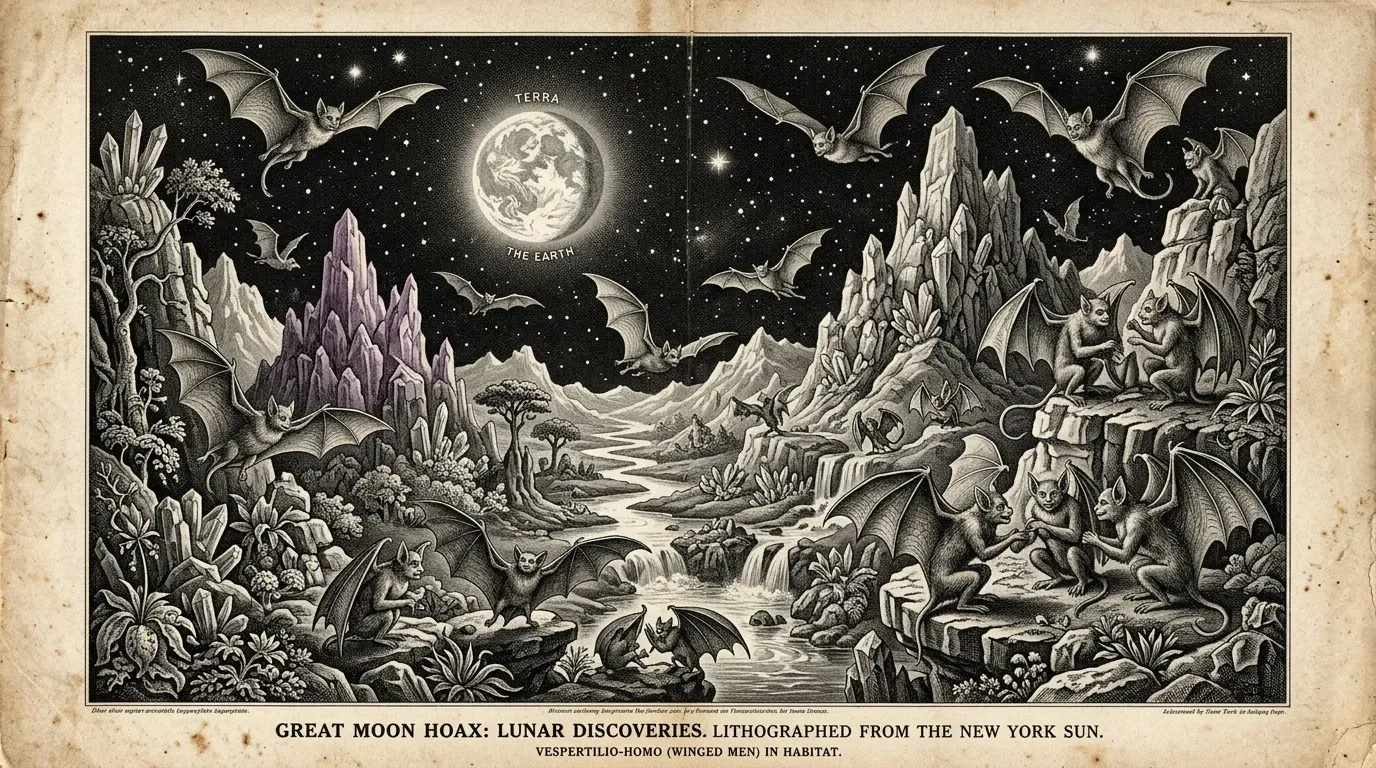
By the fourth instalment, Locke abandoned all restraint. In the lush valleys around the lunar Mare Serenitatis, the telescope discovered biped beavers that lived in huts equipped with chimneys and carried their young in their arms. Herschel supposedly remarked that these aquatic engineers possessed a degree of architecture superior to many human tribes. Then came the crowning revelation: the Vespertilio-homo, or “man-bats.”
Locke described them as four-foot-tall humanoid beings with yellow, parchment-like skin, expressive faces, and large, membranous wings extending from their shoulders down to their calves. The lens caught them bathing in lunar rivers, gliding gracefully between cliffs, eating yellow fruit, and engaging in animated conversation. Locke delicately noted that their behaviour appeared to be rational and peaceful, though in subsequent articles he hinted that their displays of public passion were somewhat too carnal for polite Victorian sensibilities.
New York succumbed to hysteria. Crowds jammed outside The Sun’s printshop on Nassau Street from dawn until dusk, fighting over each new edition as the presses ran day and night. By the end of the week, the paper’s daily circulation skyrocketed past 19,000 copies, making it the most widely read newspaper on the planet, eclipsing even The Times of London. Rival New York papers, frantic at being left behind, reprinted the dispatches and claimed to have verified the accounts through private European correspondences.
The credulity was not confined to the uneducated. A delegation of Yale professors travelled to New York to inspect the original Edinburgh journals, only to be politely given the runaround by Locke at the newspaper’s offices. In Springfield, Massachusetts, religious mission societies met to debate whether to raise funds for printing Bibles in lunar dialects to evangelize the man-bats. Edgar Allan Poe, who had published his own fictional lunar voyage (The Unparalleled Adventure of One Hans Pfaall) in the Southern Literary Messenger just two months earlier, abandoned the planned sequel in disgust, realizing that Locke had beaten him at his own game with vastly superior commercial audacity.
The hoax finally collapsed when Locke, over drinks in a tavern, admitted the fabrication to a reporter from the Journal of Commerce, who promptly published the confession. Yet when The Sun casually acknowledged the story was a satirical fantasy, the public refused to be angry. Subscriptions did not drop; they increased. Readers were delighted by the entertainment and impressed by the sheer literary panache of the deception.
Sir John Herschel, quietly mapping double stars and nebulae at Feldhausen near Table Mountain, only learned months later of the wonders he had supposedly witnessed. At first he was amused, but the joke wore thin when he was bombarded for years with letters from tourists, spiritualists, and scientific societies demanding access to his “man-bat” notes.
Locke originally conceived the serial as a satire of popular science writing, specifically targeting the Scottish theologian Thomas Dick, whose bestselling books calculated that the solar system contained exactly 21,891,974,404,480 inhabitants. But Locke underestimated the mood of the 1830s. This was a decade of astonishing, disorienting technological leaps—steam railways were shrinking continents, electrical telegraphy was in its infancy, and new religious revelations like the Book of Mormon were sweeping the American frontier. When the real world was producing miracles on an almost weekly basis, who was to say that winged men on the Moon were impossible?
I have always found the Great Moon Hoax fascinating because it marked the true beginning of modern mass media. Locke proved that in a democratic society with cheap printing and high literacy, truth is not the primary currency of journalism; narrative is. The public did not buy The Sun because they were stupid; they bought it because the story made the universe feel vast, mysterious, and alive.
Nearly two centuries later, with algorithmic feeds and digital tabloids peddling synthetic outrage and manufactured miracles, we like to think ourselves far more sophisticated than the New Yorkers who stood on Nassau Street in 1835 waiting for news of lunar beavers. But we aren’t. We are still the same creatures, standing on the pavement, eagerly paying our pennies to anyone who promises that beyond the mundane horizon, something wondrous is waiting to be found.