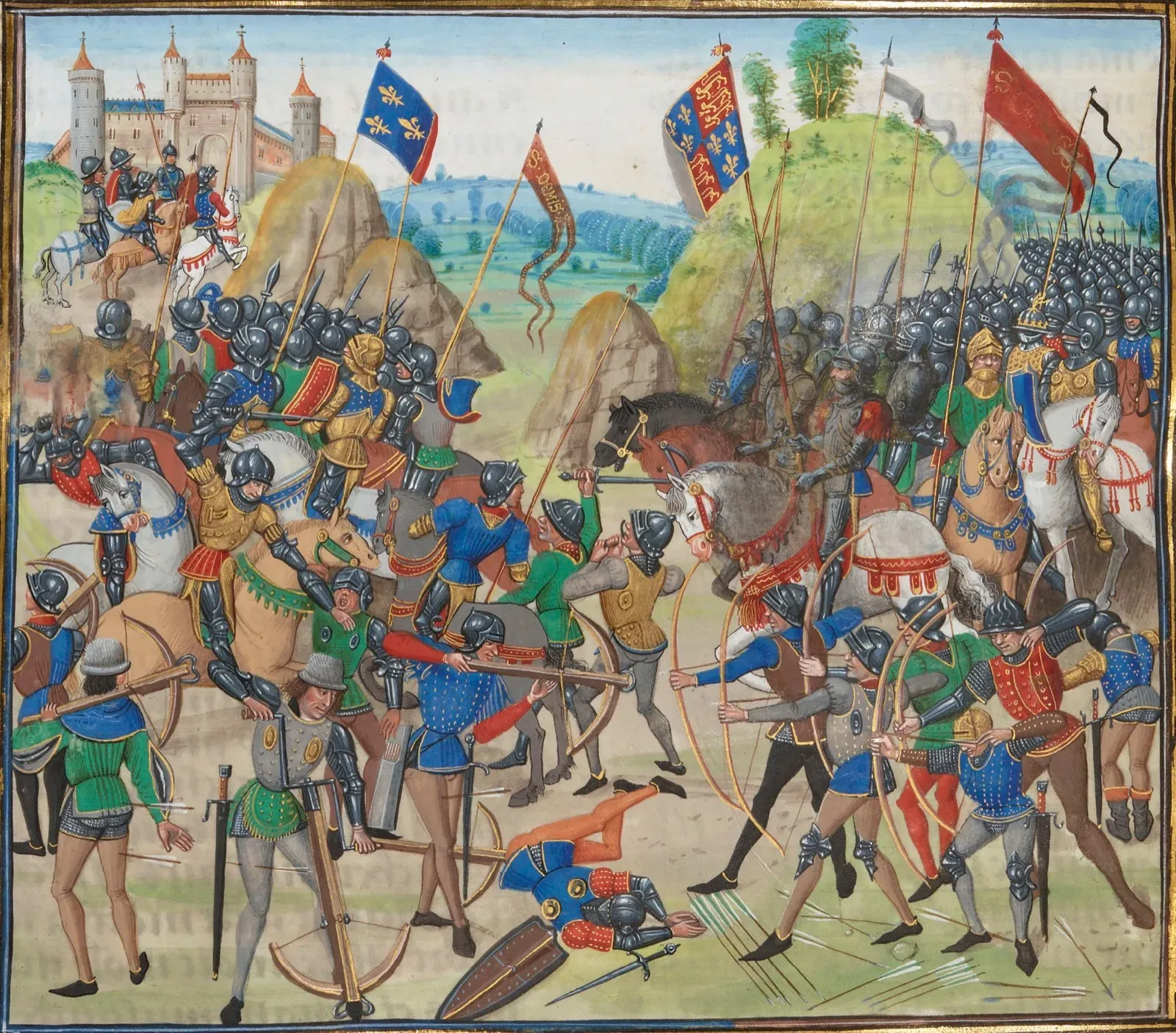
The myth of medieval chivalry died not in a royal council chamber, but in a muddy ditch in Picardy on the afternoon of 26 August 1346. For more than two centuries, the mounted knight in iron plate and chain mail had been the apex predator of European warfare. An armoured cavalry charge was the ultimate shock weapon of the feudal world, an irresistible wave of noble violence against which peasant foot soldiers were expected to break, flee, and be butchered.
I have always found the British obsession with the Battle of Crécy slightly deluded, not because the victory was unearned - it was a masterpiece of tactical discipline - but because we routinely confuse tactical perfection with strategic sense. Edward III proved that a few thousand yeomen with six-foot yew bows could slaughter the finest aristocracy of France in an afternoon. What he failed to prove, and what English monarchs would spend the next century failing to prove, was that winning battlefield set-pieces could ever conquer a kingdom three times your size.
The road to Crécy was not a grand campaign of territorial conquest; it was an opportunistic raid that spun out of control. In July 1346, Edward landed in Normandy with roughly fourteen thousand men on a chevauchée - a brutal policy of economic terror. The English burnt crops, looted abbeys, sacked Caen, and extorted ransoms, all designed to humiliate King Philip VI of Valois and prove the French Crown could not protect its own taxpayers. But by late August, Edward found himself cornered. Philip had mobilised a royal host more than twice the size of the English force, pursuing Edward to the River Somme. The English barely slipped across the tidal ford at Blanchetaque hours ahead of the French vanguard.
Realising he could not outrun the French cavalry indefinitely, Edward chose his ground with cold precision. On the gentle ridge between the villages of Crécy-en-Ponthieu and Wadicourt, he drew up his army in three dismounted divisions and dug protective pits and ditches along his front and flanks. By ordering his knights and earls to fight on foot alongside common soldiers, Edward committed to an uncompromising tactical doctrine: there would be no noble retreat while the infantry died. At the forward right of his line stood his sixteen-year-old son, Edward of Woodstock - later romanticised as the Black Prince - whom the king famously refused to reinforce during the thick of the fighting so the boy could “win his spurs”. Flanking the dismounted men-at-arms in triangular, harrow-like formations stood several thousand English and Welsh longbowmen, armed with heavy yew bows capable of firing armour-piercing bodkin points with a draw weight well over a hundred pounds.
The longbow was not merely a weapon; it was a socio-economic system that no other European realm could replicate. Carved from imported Spanish and Italian yew, a medieval war bow required immense physical strength to draw - so much so that modern excavations of longbowmen from the Mary Rose reveal warped left arms and thickened shoulder bones permanently deformed by childhood practice. While French kings relied on aristocratic retinues and hired foreign mercenaries, the English Crown had turned its rural yeomanry into a deadly caste of archers who could deliver sustained ballistic firepower at two hundred metres.
When Philip VI’s army arrived in late afternoon, they were exhausted, disordered, and bloated with aristocratic vanity. The French nobility viewed war not as an exercise in coordinated military discipline, but as a tournament stage for personal honour. When Philip and his veteran marshals suggested halting overnight to reform their strung-out ranks, the dukes and counts in the vanguard pushed past them in a scramble to be the first to draw English blood. To soften the ridge, Philip sent forward six thousand Genoese mercenary crossbowmen.
Then the sky opened. A sudden late-summer thunderstorm swept the hillside, turning the dry soil into slippery mud. The Genoese, who had marched miles without their heavy protective pavises left behind in the baggage train, saw their crossbow cords slacken in the rain. The English archers simply unstrung their bows and slipped the hemp strings beneath their caps to keep them dry. When the clouds parted and the blinding late-afternoon sun shone directly into the eyes of the French, the Genoese advanced, shouting their battle cries, and fired. Their wet cords threw their bolts hopelessly short.
The English response was merciless. A trained longbowman could loose ten to twelve aimed arrows a minute, maintaining a continuous, whistling blizzard of steel and goose feather. The Genoese ranks disintegrated under the hail within minutes. As the panic-stricken mercenaries fell back down the slope, Philip and his knights reacted with pure aristocratic contempt: believing the Genoese to be cowards, the French cavalry charged forward and rode down their own retreating allies, trampling hundreds under iron horse hooves.
What followed was not a battle; it was an industrial execution. Over the next six hours, the French cavalry launched fifteen or sixteen separate, chaotic charges up the slippery slope. Uphill through mud, over dead crossbowmen, and straight into a curtain of arrows, the heavy warhorses never gained momentum. The English archers targeted the unarmoured flanks of the horses. Wounded beasts panicked, threw their riders, and crashed back into the advancing ranks. French knights, weighed down by heavy iron, tumbled into drainage ditches where Welsh and Cornish infantry moved through the carnage with long skinning knives.
Chivalric romanticism could not survive that butchery. The blind fifty-year-old King John of Bohemia, refusing to leave the field without striking a blow, had his horse’s bridle tied between two of his knights and rode straight into the melee; all three were found dead the following morning, still lashed together. By midnight, Philip VI had fled the field with an arrow wound to his face. Behind him lay the ruling elite of France: a duke, nine counts, dozens of great barons, over fifteen hundred knights, and thousands of foot soldiers. English fatalities barely reached a few hundred.
The immediate fruit of Crécy was tangible. Flushed with victory, Edward marched his intact army north to the coast and began the long siege of Calais. When the port surrendered eleven months later, England acquired a fortified continental bridgehead that it would hold for over two centuries. At home, longbow archery became an English civic religion, enforced by royal statutes that banned football, dice, and handball in favour of compulsory Sunday practice at the parish butts.
Yet if you look past the tactical triumph, Crécy exposed the fundamental impossibility of the English war aim. Edward III claimed the French crown, but you cannot govern sixteen million hostile Frenchmen by burning their farms and shooting their nobility in an afternoon. England, with a population barely one-fourth that of France, lacked the tax base, the administrative depth, and the garrison manpower to occupy the kingdom. The English war effort remained trapped in the logic of the chevauchée - an extortion racket that produced sensational victories at Poitiers and Agincourt, but left the surrounding country unconquered and deeply resentful.
Whenever the French refused to fight set-piece battles and instead relied on patient attrition - as Bertrand du Guesclin did a generation later, and as French commanders did after the siege of Orléans - the English continental empire dissolved. Heavy cavalry could indeed be shattered by yeoman archers, but yeoman archers could not hold Gascony or Normandy against a state with vastly superior resources. A century after Crécy, French standing armies and field artillery blasted the English off the continent at Castillon, ending the dream of an English-ruled France forever.
On 26 August 1346, Edward III and his archers proved that a well-drilled line of commoners with staves of yew and strings of hemp could dismantle the proudest aristocracy in Christendom. It was a stunning, bloody spectacle that rewrote the rules of medieval warfare. But winning the battle was the easy part; the English spent the next hundred years discovering that no blizzard of arrows could shoot an empire into existence.