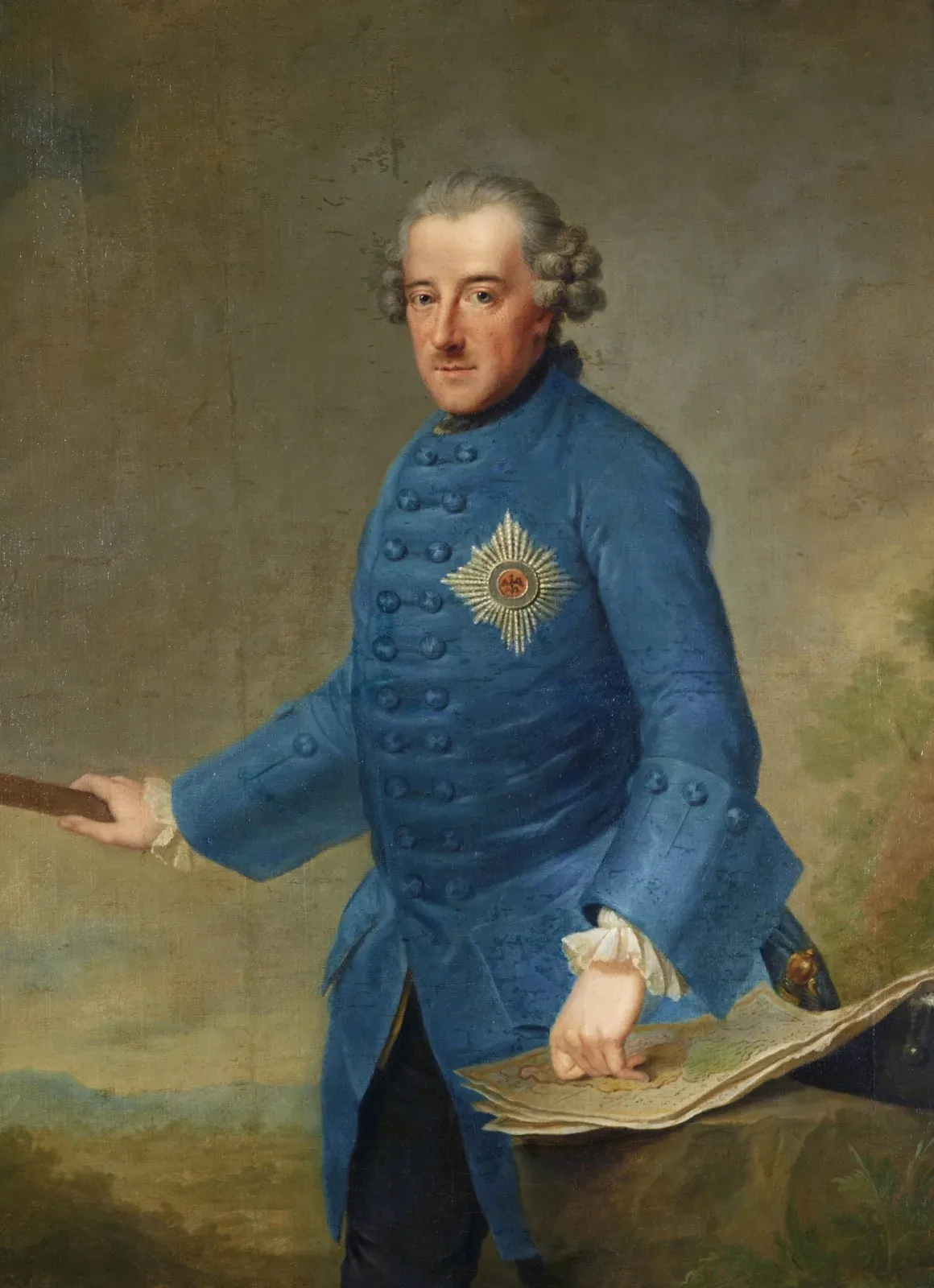
On the morning of 29 August 1756, Frederick II marched seventy thousand Prussian troops across the border into the neutral Electorate of Saxony without bothering to declare war. It was an act of cold geopolitical piracy that caught Europe completely flat-footed. Within weeks, the Prussian army had occupied Dresden, looted the Saxon state treasury, forced twenty thousand captured Saxon soldiers into Prussian uniforms, and kicked off the continental inferno of the Seven Years’ War. Frederick presented his invasion as a reluctant, defensive strike against an imminent encirclement. In reality, it was the opening gambit of a desperate monarch who knew he had backed himself into a corner from which only total war could extract him.
I have always found the popular caricature of Frederick the Great - the flute-playing philosopher-king of Sanssouci who casually out-thought the crowned heads of the Continent - slightly detached from the terrifying arithmetic of what he actually did. In August 1756, Prussia was not a great power by any standard metric; it was a militarised sandbox. With a population of barely four million people scattered across disjointed territories from the sands of Pomerania to the Rhineland, Prussia was taking on a coalition whose combined subjects numbered over eighty million. It was not a calculated strategic gamble; it was an act of magnificent lunacy.
What Frederick had unleashed was the European cockpit of the Seven Years’ War, a bloodletting engineered by the Diplomatic Revolution of 1756. Sixteen years earlier, upon ascending the throne in 1740, Frederick had seized the wealthy, industrialised province of Silesia from the young Habsburg archduchess Maria Theresa. Austria had never forgiven the theft. Maria Theresa spent the following decade reorganising her armies, modernising her administration, and plotting the destruction of the upstart Hohenzollern realm.
In Vienna, the Austrian State Chancellor Wenzel Anton von Kaunitz pulled off what three centuries of European statecraft had deemed impossible: he reconciled the Habsburgs with their hereditary enemy, Bourbon France. When London signed the Treaty of Westminster with Prussia to protect Hanover, Paris immediately concluded a defensive pact with Vienna. To complete the noose, Empress Elizabeth of Russia, who nurtured an intense personal loathing for the Prussian king, joined the alliance. By mid-1756, Austria, France, Russia, Sweden, and Saxony had formed a ring of iron around Prussia, committed not merely to reclaiming Silesia, but to partitioning Frederick’s kingdom down to its original, insignificant Brandenburg core.
Frederick’s operational response was ferocious. Trapped on interior lines, he adopted a doctrine of relentless aggression, striking each enemy before they could concentrate their forces. At Rossbach in November 1757, he outmanoeuvred and obliterated a combined Franco-Imperial army twice his size in ninety minutes, losing barely five hundred men while inflicting over seven thousand casualties. A month later at Leuthen, executing his textbook oblique order against thirty thousand more Austrians, he routed Maria Theresa’s finest army in three hours. These victories entered European military lore and made Frederick a folk hero across Protestant Europe.
Yet tactical virtuosity could not alter the grim laws of attrition. Prussia possessed no strategic depth and no bottomless reservoir of peasant conscripts. Every veteran Prussian infantryman who died in the mud of Saxony or Bohemia was irreplaceable. At Zorndorf in August 1758, Frederick met the Russian army in a blind, brutal slaughterhouse of thirty-two thousand casualties; both sides ran out of ammunition and fought with bayonets, musket butts, and bare fists until nightfall. The Russians fell back, but the Prussian army was bleeding white.
The inevitable catastrophe arrived on 12 August 1759 at Kunersdorf, east of Frankfurt an der Oder. Facing an entrenched Austro-Russian army under General Pyotr Saltykov, Frederick’s exhausted columns were methodically ripped apart by artillery and swept away by Russian cavalry charges. The king lost nineteen thousand men, his entire artillery park, and his royal baggage. Frederick had two horses shot out from under him; a gold snuffbox in his breast pocket deflected a Russian musket ball that would have pierced his chest. With barely three thousand demoralised soldiers left under his immediate command, Berlin lay completely exposed, fifty miles to the west.
Frederick broke down entirely. He handed command of the remnants to his brother Prince Henry, carried a case of porcelain poison vials in his pocket, and wrote to his chief minister in Berlin: “I have no more resources, and to be honest, I think everything is lost. I will not survive the ruin of my fatherland.”
What saved Prussia in late August 1759 was not military brilliance, but the timid, bureaucratic paralysis of his enemies. Saltykov and the Austrian commander, Field Marshal Leopold von Daun, were crippled by mutual suspicion and logistical exhaustion. Saltykov, having lost fifteen thousand men, refused to march on an undefended Berlin without Austrian guarantees, famously remarking that another such victory would leave him returning to Saint Petersburg with a walking stick in his hand. Daun, notoriously cautious, dithered in Silesia and hesitated to commit his cavalry. Instead of marching on Berlin to end the war, the allied armies argued over supply trains, hesitated for four weeks, and then retreated across the Oder into winter quarters. A stunned Frederick christened their failure to strike the death blow the “Miracle of the House of Brandenburg”.
Yet allied caution could only postpone the executioner. By the winter of 1761, Prussia was reduced to an armed camp of ghosts. Berlin had been raided and ransomed, Prussian currency had been debased three times, teenage boys and prisoners of war filled the ranks, and the British government under Lord Bute abruptly cut off the annual subsidies that funded the army. Russian armies wintered in Pomerania and stood poised to deliver the final blow in the spring campaign of 1762. Frederick, gaunt and prematurely aged in his threadbare uniform, sat in his field tent awaiting the end.
Then, on 5 January 1762, the real miracle happened: Empress Elizabeth of Russia died of a throat haemorrhage at the age of fifty-two.
Her successor, the twenty-three-year-old Peter III, was an erratic, obsessive Germanophile who worshipped Frederick the Great with religious devotion. Peter wore Prussian blue, displayed portraits of Frederick in his private apartments, and referred to the Prussian king as his master. Within weeks of ascending the Russian throne, Peter overturned Russia’s foreign policy overnight. He declared an unconditional ceasefire, signed the Treaty of Saint Petersburg in May 1762, and returned every inch of conquered Prussian territory - including the whole of East Prussia, which Russia had already formally annexed - without demanding a single rouble of indemnity. To the fury of Vienna and Versailles, Peter then ordered twenty thousand Russian troops under Zakhar Chernyshev to join Frederick’s army and fight against Austria.
Although Peter was overthrown and murdered six months later in a palace coup orchestrated by his wife, Catherine the Great, Catherine was far too shrewd to resume a ruinous war that had drained the Russian treasury. Sweden followed Russia out of the conflict. Left alone on the continent and bankrupt, with France losing its overseas empire to the British - an imperial collapse formalised in the Treaty of Paris - Austria could not defeat Prussia in isolation.
On 15 February 1763, Prussia and Austria signed the Treaty of Hubertusburg. Not a single border changed. Silesia remained firmly in Prussian hands. After seven years of industrial slaughter that consumed over a million European lives, Prussia had held off the combined might of three continental superpowers and emerged as an acknowledged great power.
Frederick did not spend the remaining twenty-three years of his reign writing victory odes. He understood how close his state had come to the abyss. He threw himself into domestic reconstruction with the same ruthless energy he had brought to the battlefield. He drained the marshes of the Oderbruch, built state granaries to stabilise grain prices against famine, reformed the judiciary, promoted silk and porcelain manufactures, and reorganised the tax system. In 1772, he engineered the First Partition of Poland, connecting East Prussia to Brandenburg without firing a shot and securing the geographic cohesion his kingdom had always lacked. That administrative machinery and territorial foundation ultimately set Prussia on the road to dominating central Europe and creating the German Empire a century later.
On 29 August 1756, Frederick the Great invaded Saxony because he believed speed and audacity could overturn the laws of arithmetic. It brought his country to the absolute brink of destruction. We like to pretend that great nations rise through institutional inevitability and grand historical design. The rise of Prussia tells a far more unsettling truth: that modern Europe was forged because two allied generals could not agree on a baggage train, and a Russian empress caught a winter cold at the exact moment the executioner had raised his axe.