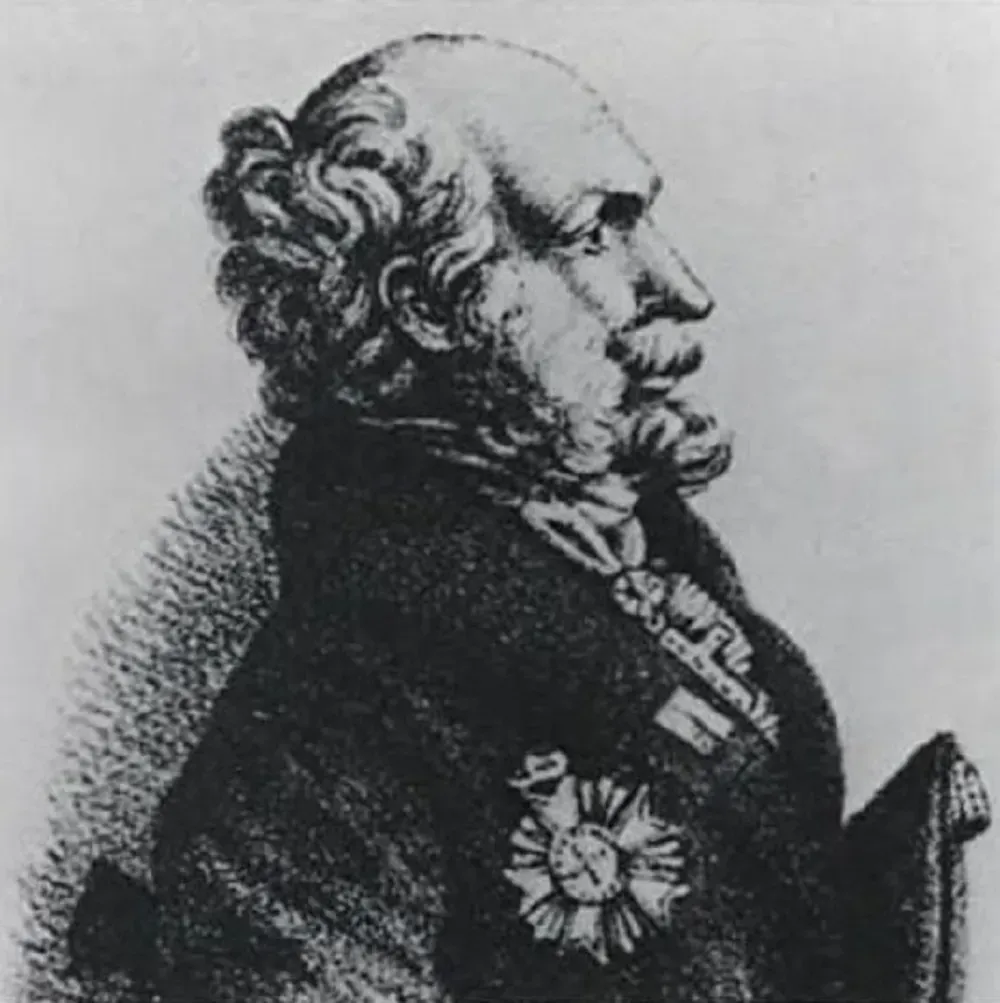
On 18 July 1817, a German doctor named Georg Anton Schäffer boarded a ship and left the Hawaiian islands for good. He had spent two years trying to turn them into a Russian possession. He failed. The Russian-American Company later counted the bill at somewhere between 200,000 and 230,000 rubles. The Tsar refused a protectorate. History filed the episode under curiosities and moved on to the Alaska Purchase, which everyone remembers because it stuck.
I keep coming back to that contrast. Alaska was Russian, and then it was American, and schoolchildren can recite the punchline. Hawaii was almost Russian too - not for a generation, not as a settled colony with Orthodox churches and sea-otter warehouses, but as a real attempt by a company agent who raised the company flag, built stone forts, renamed valleys after himself, and signed treaties with a Hawaiian king who promised him an army. If Schäffer had kept his footing, the middle of the Pacific might have hosted another Russian enclave for decades. That is not a parlour counterfactual. It is what nearly happened.
The story starts with a wreck. In January 1815 the Russian-American Company ship Bering ran aground at Waimea on Kauai during a storm. Its cargo - furs and supplies worth roughly 100,000 rubles, bound for the hungry settlements of Russian America - became the prize of Kaumualii, the island’s ruler. Captain James Bennett later claimed the chief had seized both ship and goods. Whether that was plunder or Hawaiian custom applied to a gift from the sea depends on which account you trust. Either way, Alexander Baranov, the company’s governor in New Archangel, had a problem. American captains in his employ pressed for a punitive expedition. Baranov preferred a quieter recovery.
He sent Schäffer.
Schäffer was a physician who had served on the company ship Suvorov. He was available. The better officers were elsewhere - on Kodiak, at Fort Ross in California. Baranov’s instructions were limited: pose as a harmless naturalist, court King Kamehameha I, recover the Bering’s cargo or take sandalwood as compensation, and, if things went smoothly, secure a sandalwood monopoly. Force was a last resort. Podushkin, who arrived later with the ship Otkrytie, carried orders that if peace failed, Kauai should be taken in the name of the Emperor. The mission was recovery dressed as exploration. Schäffer turned it into conquest dressed as diplomacy.
He reached the islands in November 1815. American advisers around Kamehameha - John Young among them - smelled a cover story immediately. Schäffer bought his way back into favour by treating the king and Queen Kaahumanu, then planted maize and tobacco on Oahu and waited for reinforcement. When talks with Kamehameha stalled, he sailed for Kauai in May 1816. Kaumualii was waiting for exactly this kind of visitor.
Who was using whom
Here is the part that makes Schäffer look less like a conqueror and more like a useful idiot. Kaumualii still ruled Kauai and Niihau as a semi-independent power under Kamehameha’s expanding kingdom. He wanted foreign ships and foreign leverage. During the War of 1812 he had courted the Americans; by 1815 that alliance had gone cold. Schäffer arrived with Russian guns, Russian ships, and a willingness to believe flattering treaties. Within days Kaumualii pledged allegiance to Tsar Alexander I, agreed to repay the Bering losses, and granted the company a sandalwood monopoly. He raised the Russian-American Company flag over Kauai while wearing a Russian naval uniform. A further treaty in July 1816 promised Schäffer 500 Hawaiian soldiers for an assault on Oahu, Maui, Lanai, and Molokai, plus a ban on trade with Americans. Kaumualii had no intention of becoming a Russian vassal. He was renting a European doctor to frighten his rivals.
Schäffer, for his part, lost contact with reality at an impressive speed. He put hundreds of Hawaiians to work building Fort Elizabeth, a European-style star fort of stone and adobe, armed with cannon by the end of 1817. He laid out two smaller earthen works, Fort Alexander and Fort Barclay-de-Tolly. He renamed the Hanalei valley Schäfferthal. He bought ships from American sellers on Kaumualii’s behalf, including the Avon for 200,000 Spanish dollars - a purchase Baranov refused to honour. He wrote triumphant reports to Sitka and St Petersburg requesting a naval expedition to protect what a contemporary called his “almost lunatic schemes.” The schemes looked solid only if you ignored who was playing whom.
They collapsed in stages. In September 1816 he had to evacuate a foothold on Oahu under threat of violence. That December, Otto von Kotzebue arrived in the Rurick on a circumnavigation. Kamehameha lined the coast with hundreds of men, expecting a Russian landing. Kotzebue talked him down and made clear that the Imperial government had nothing to do with Schäffer’s private empire. He never even visited his compatriots on Kauai. American merchants pressed to pull down the Russian flag. In June 1817 Schäffer’s American employees deserted him. Local Hawaiians bundled him into a boat. He tried to make a stand at Fort Alexander and failed. He limped to Honolulu on the leaking Kadyak, left dozens of Russians and Aleuts stranded on Oahu, and finally quit the islands. His victory letters were still travelling toward St Petersburg while he was already gone.
The aftermath is as telling as the adventure. Company directors briefly warmed to the idea when Schäffer’s glowing treaties arrived, then cooled when the foreign ministry asked London’s ambassador what Britain would think of a Russian protectorate in Hawaii. Count von Lieven’s answer was that the risks outweighed the gains. In March 1818 Nesselrode and Alexander agreed. The Tsar would not take Kauai under his wing. He did send Kaumualii a medal of the Order of St Anna, which is the imperial equivalent of a polite handshake after declining a merger. The company kept poking at a “Hawaiian project” into 1821, then sued Schäffer for the damage and eventually let him slip back to Germany. He later turned up in Brazil with a box of Hawaiian specimens and another colonial scheme. Some men do not learn; they relocate.
The near miss
What interests me is not Schäffer’s vanity, which is obvious, but the near miss. Russian America was not a cartoon fringe. It ran from Alaska down to Fort Ross in California. Its ships already called at Hawaiian ports for food. A secured Kauai - sandalwood, provisions, a fort commanding the sea lanes - would have given the company a Pacific hub between Sitka and Canton. Americans on the ground understood the stakes well enough to sabotage the flag and peel away Schäffer’s crew. London understood them well enough to discourage St Petersburg. The islanders understood them best of all: Kaumualii used Russia; Kamehameha outlasted it; neither intended to become a footnote in someone else’s empire. (Another Pacific transfer that did stick: the Hong Kong handover in 1997.)
Alaska sold in 1867 because Russia decided the colony was expensive and indefensible. Hawaii never sold because Russia never quite owned it. On 18 July 1817 the difference between those two sentences was a German doctor on a departing ship, a leaking hull full of sandalwood, and a Russian flag that had flown over Kauai just long enough to prove the point. Empires remember the territories they keep. They should also remember the ones they almost took - they often carry valuable lessons.