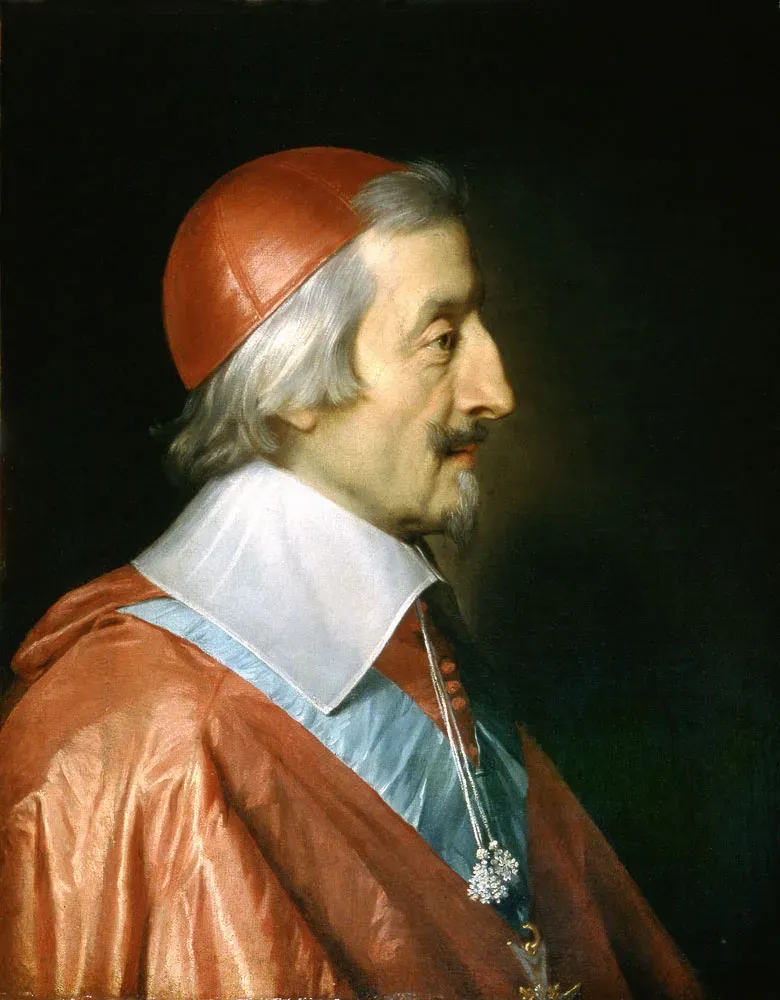
In the spring of 1624, Charles de La Vieuville needed a favour from Marie de Médici. He was negotiating the marriage of her daughter Henriette Marie to the future Charles I of England, the queen mother’s help mattered to the deal, and her price for helping was clear: her old ally, the Bishop turned Cardinal Armand Jean du Plessis de Richelieu, was to have a seat on the royal council. La Vieuville agreed, but tried to cap the damage. He offered Richelieu a “council of despatches” - an advisory role with a fine title and no actual power. Richelieu objected loudly enough that Louis XIII settled the argument himself, naming him a full member of the council on 29 April 1624. La Vieuville had just handed a council seat, and four months of proximity to the king, to the one man in France capable of using both to end his career. He was right to worry. He was worried not nearly enough.
By then Richelieu was 38 and had already lived one entire political life and lost it. He’d become Bishop of Luçon at 21, young enough that he needed a special dispensation from Pope Paul V to take the post, and had made himself the first bishop in France to actually implement the reforms the Council of Trent had ordered sixty years earlier and everyone else had quietly ignored. He rose through the household of the queen mother’s favourite, Concino Concini, took a Secretary of State post in 1616, and lost everything in 1617 when a rival faction had Concini assassinated in the courtyard of the Louvre. Richelieu was stripped of office and banished to Avignon, where he spent his exile writing a catechism. He talked his way back into relevance in 1619, mediating between Marie de Médici and the son she’d tried to overthrow, made cardinal in 1622, and by early 1624 had become - through Huguenot rebellions and general crisis - too useful for the king to keep sidelined any longer. None of this suggested a man who’d accept a decorative council seat and stay quiet.
He didn’t. Richelieu spent the following months paying pamphleteers to wreck La Vieuville’s reputation, methodically converting the minister’s mismanagement of the royal finances into a public scandal. It took him roughly three months. On 12 August 1624, Louis XIII had La Vieuville arrested on corruption charges and shipped off to the Château d’Amboise. The following day, Cardinal Richelieu took his place as the king’s chief minister - though, in a small detail that says a great deal about how carefully he managed his own ascent, he let the Cardinal de La Rochefoucauld keep the nominal title of council president for another five years before claiming it outright in 1629. Richelieu did not need the title to have the power. He would spend the rest of his life demonstrating exactly how little the two things had to do with each other.
What he built with that power was the modern French state, more or less by force. He abolished the office of Constable of France in 1626 and ordered noble castles razed across the kingdom, stripping the aristocracy of the fortified bases it had used for centuries to fight the crown on its own terms. He besieged the Huguenot stronghold of La Rochelle in person for over a year until it fell in 1628, breaking Protestant political and military power in France while - and this distinction mattered - leaving the religious toleration granted by the Edict of Nantes intact. He replaced local tax officials, half of them corrupt and none of them loyal to Paris, with intendants who answered directly to the crown. None of it was gentle. When the duc de Montmorency rose against him in 1632, Richelieu had him executed. When a critic named Urbain Grandier became inconvenient in 1634, he was burned at the stake in the Loudun affair. Richelieu ran an internal spy network large enough to know about most plots against him before they matured, including the one Marie de Médici herself organised in 1630, the “Day of the Dupes,” when the woman who had raised him to power tried to have him dismissed and instead got herself exiled. Both the minister he replaced and the patron who made him were, eventually, casualties of the same career.
His foreign policy ran on the same cold logic. He was a cardinal of the Catholic Church who spent the 1630s bankrolling Protestant Sweden and allying with the Dutch Republic against Catholic Spain and Austria, because checking Habsburg power mattered more to him than confessional solidarity. Reason of state came before religion, and he said so plainly enough that Rome never fully forgave him for it. He was, in the meantime, also finding time to found the Académie Française, patronise Corneille’s theatre, and - by one persistent and rather charming account - ban sharp-pointed dinner knives at his own table in 1637 because his guests kept using them to pick their teeth. The habit spread to the rest of France and gave the country the rounded table knife it still uses. Even his table manners were an exercise in imposing order on people who hadn’t asked for it.
This is the man Alexandre Dumas turned into the chief plotter menacing four swordsmen in The Three Musketeers, published in 1844, more than two centuries after Richelieu’s death. Dumas’ readers didn’t need him explained. They already knew Richelieu as the man who had spent eighteen years dismantling the feudal nobility, building the tax and spy apparatus of a centralised state, and handing his successor Mazarin the tools to raise a child king who would grow up to declare, more or less, that he was the state in person. Louis XIV’s absolutism didn’t spring from nowhere in the 1660s. It was assembled decades earlier, piece by piece, by a sickly former bishop with a talent for outlasting everyone who tried to contain him.
Which is really the whole story, condensed into one summer. Charles de La Vieuville thought he was doing himself a modest favour, buying a marriage alliance with a council seat he’d carefully hollowed out in advance. Four months later he was under guard at Amboise, and the man he’d tried to keep powerless was running France. Richelieu didn’t need to seize power on 12 August 1624. The minister who feared him least had already handed it over.